Every bite is a decision — feeding the toy-breed envelope
The bowl is small because she’s small. You measure carefully. You watch her eat. And — most days, quietly — you wonder whether what’s in front of her is enough, or whether what looks like enough is just what fits.
Here’s what the math actually says. At the toy-breed end, a 2-kilogram adult needs roughly 40% more energy per kilogram than a 7-kilogram adult. Less to work with. More riding on it. For a toy breed, every bite is a decision — and the research underneath that says so by measurement, not by metaphor.
There are two halves to say out loud here. There’s real math at the toy-breed end — the kind that earns the way the brand talks. There’s also a category cliché the math doesn’t back up. We hold both. The math is the rigour. Refusing to claim what the research hasn’t measured is the discipline.
How much should I feed my chihuahua, yorkie, or toy poodle?
Start with the calculator, then read the body. A toy breed lives on a tighter calorie margin than a mid-small breed, because energy demand scales by metabolic body weight, not by total weight — a 2-kilogram adult needs more energy per kilogram than a 4 or 7-kilogram adult does. The calculator does that math. The bag chart often doesn’t. Body condition finishes the read month to month and across three months. The math is where you start. The dog finishes it.
Why do toy breeds need more food per kilogram than larger dogs?
The math is in the kilos, not in the breed. Energy demand in dogs scales by metabolic body weight (BW⁰·⁷⁵), not by raw weight, and that curve gets steeper at the toy-breed end. By the canine maintenance equation, a 2-kilogram adult needs roughly 40% more energy per kilogram than a 7-kilogram adult ¹. The breed label doesn’t add to that. The kilos do.
Should I feed my toy breed three or four times a day?
Sometimes. Feeding often makes sense, especially at very small body weights, and especially when something about the day isn’t ordinary — illness, recovery, travel, a long stretch of hard exercise. But in a healthy adult toy breed in normal home life, it isn’t a proven way to guard against hypoglycaemia. Nobody has run direct feeding-interval trials on adult toy breeds in the 1–3 kilogram range. Read the day. If it’s a quieter one, two meals are usually fine. If it isn’t, more meals are.
Is my adult toy breed at hypoglycaemia risk between meals?
Where the evidence is solid: puppies. Where it stays open: adults. The strongest published canine evidence for primary low-blood-sugar risk sits in newborns and very young toy-breed puppies. In healthy adult toy breeds in normal home life, the research hasn’t measured what the wellness category often assumes. Where the situation itself narrows the margin — major surgery, illness, days that don’t repeat — the risk is real and watching closely makes sense. Outside those situations, the worry usually outruns the evidence.
The math underneath
Energy needs in dogs don't scale in a straight line with body weight. They follow a curve — one that accounts for body surface area rather than raw weight — which the canine research has been expressing for half a century as BW raised to a power between 0.64 and 0.75². The exact number varies slightly between studies. The shape doesn't. At the small end, the curve gets steeper. Smaller dogs need more energy per kilogram than larger dogs.
For very small dogs, this gets sharp. By the formula in Divol & Priymenko (2017) study, a 2-kilogram adult needs roughly 40% more energy per kilogram than a 7-kilogram adult. That isn't breed biology. It's body-size math, measured consistently across the field.
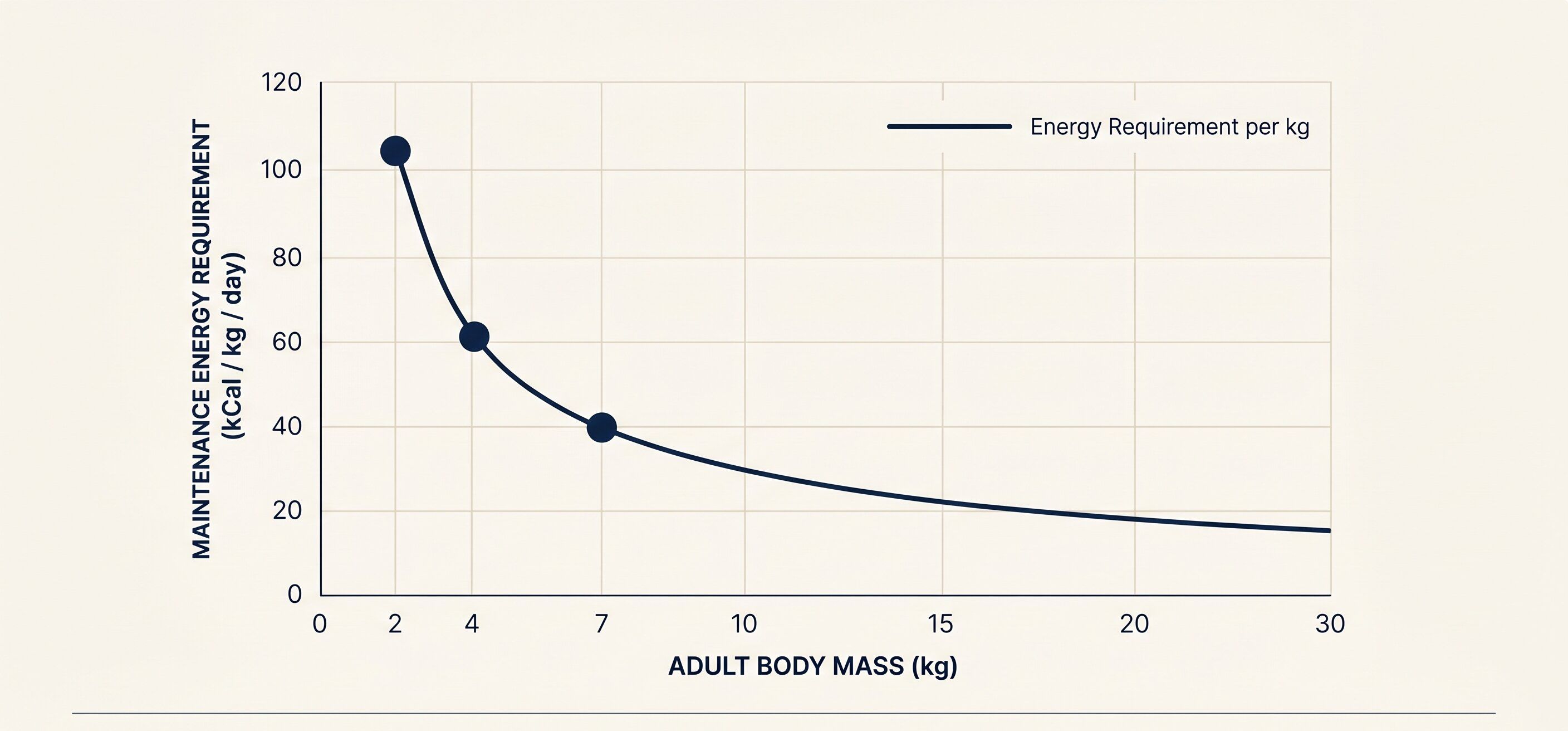
The difference between a 2-kilogram dog and a 4-kilogram dog isn't the breed name on the bag. It's the kilos and the curve. There's no need to invent a separate small-dog metabolism — the math already accounts for it. Thes and colleagues (2016) studied 586 real pet dogs and found that once you calculate energy intake using the right unit for body size, dog size made no difference to the result. Across a wide range of body sizes, the formula held. The idea that small dogs digest food differently doesn't survive once you use the right unit.
The unit is what changes. The biology doesn’t. The math is in the kilos, not in the breed.
What the math means at the bowl
A tighter calorie margin shows up in two places. Density and treats.
Density first. If the calorie budget is small, the food has to carry more nutrition per gram, because there are fewer grams in the day. Each bite has to do more work. This is the plain truth at the toy-breed end — less to work with, more riding on it — and it’s why a small-dog kibble built for a small mouth isn’t the same thing as a smaller serving of a large-breed bag. The kibble piece, the calorie density, the protein-to-fat balance, the ingredients tuned to a smaller intake all matter more, because the day is shorter.
Treats next. The 10% rule isn’t a guideline. It’s structural math. A 2-kilogram dog’s daily energy need is, depending on activity, somewhere between 130 and 220 kilocalories. Ten per cent of that is 13 to 22 kilocalories — grams, not handfuls. A single dental chew made for a mid-small-breed dog can clear that line on its own. The math doesn’t care what you meant.
A solid starting point is still just a starting point. The TENDS feeding calculator uses an FEDIAF-aligned maintenance energy model, scales by metabolic body weight (BW⁰·⁷⁵, the unit the canine literature backs up), and is calibrated to the metabolizable energy of this specific food at 3.827 kilocalories per gram. The activity-level spread alone moves daily intake roughly 84% across the calm-to-very-active range. The number on the screen is the math. The body finishes the read.
What the math doesn’t support
The math is sharp. The research on everyday hypoglycaemia in adult toy breeds is not. The strongest published canine evidence for primary low-blood-sugar risk sits in newborn and very young toy-breed puppies — small body, immature liver, limited glycogen reserve. That research is real³. In healthy adult toy breeds in normal home life, the picture is different. The 2018 Journal of Small Animal Practice hypoglycaemic-crises review describes adult toy-breed hypoglycaemia as anecdotal in the literature⁴. Nobody has run direct feeding-interval trials on adult toy breeds in the 1–3 kilogram range.
What the research does back up is specific situations. The clearest example is major heart surgery: in 84 dogs undergoing heart valve repair, low blood sugar after the operation occurred in 14.2% — and the affected dogs were noticeably smaller (around 2.4 kg on average) than the others (around 4.1 kg on average). Chihuahua was the most common breed in the group⁵. Being very small was itself a risk factor in that context. The reason the authors suggest — heat loss and energy burned during surgery that drops body temperature — is the kind of situation where the margin shrinks. It isn't what happens to healthy adult dogs in normal daily life. Where the evidence is solid: puppies. Where it stays open: adults. Being honest about that distinction is the point.
Feeding three or four times a day — often shared by toy-breed parents with years behind them — makes sense as a precaution in those specific situations. On current evidence, it isn't something the research supports as a rule for healthy adult toy breeds in normal home life. Both things are true. Both go in the wording. At the toy-breed end, the research hasn't yet measured what TENDS might otherwise have leaned on — and the brand that says so openly is the one worth trusting.
How to feed inside the envelope
Five principles. Not a schedule. The schedule belongs to the day. The principles belong to the math.
Start at the calculator. A bag chart is a population average. The TENDS feeding calculator is the math at the resolution your dog actually lives in. Use it. Treat it as the solid starting point it is.
Feed for the body, not the chart. Body condition reads what the math can’t — which way her weight is heading, the muscle-to-fat ratio, the ribs you should feel through gentle pressure but not see. The chart gives you a starting point. The body finishes the read month to month and across three months. How to read your dog walks you through watching her; how much to feed a small dog walks you through body condition specifically.
Every bite is a decision because there are fewer of them. This is what density pressure means in practice. A food that’s a little more calorie-dense, tuned to a smaller intake, reaches further on a smaller budget. The bowl looks the same. What’s inside it is doing more.
Treat math is structural, not optional. Ten per cent of a small dog’s daily energy is small in absolute terms. Treat-frequency choices are calorie choices. A treat built for a small body — air, not weight — lets you say yes more often without spending the whole day’s math in one go.
Watching the margin is its own discipline, not a protocol. The toy-breed parent who notices appetite, energy, stool, coat, and weight day to day is doing the work the math hands off. Watch the margin, not the dog. The dog reports the margin in detail. The parent reads what the dog reports. Not as a metabolic-fragility protocol — as ordinary attention. When the day is ordinary, two meals are usually fine. When it isn’t, more meals are. Read the day.
What that looks like in TENDS’ system
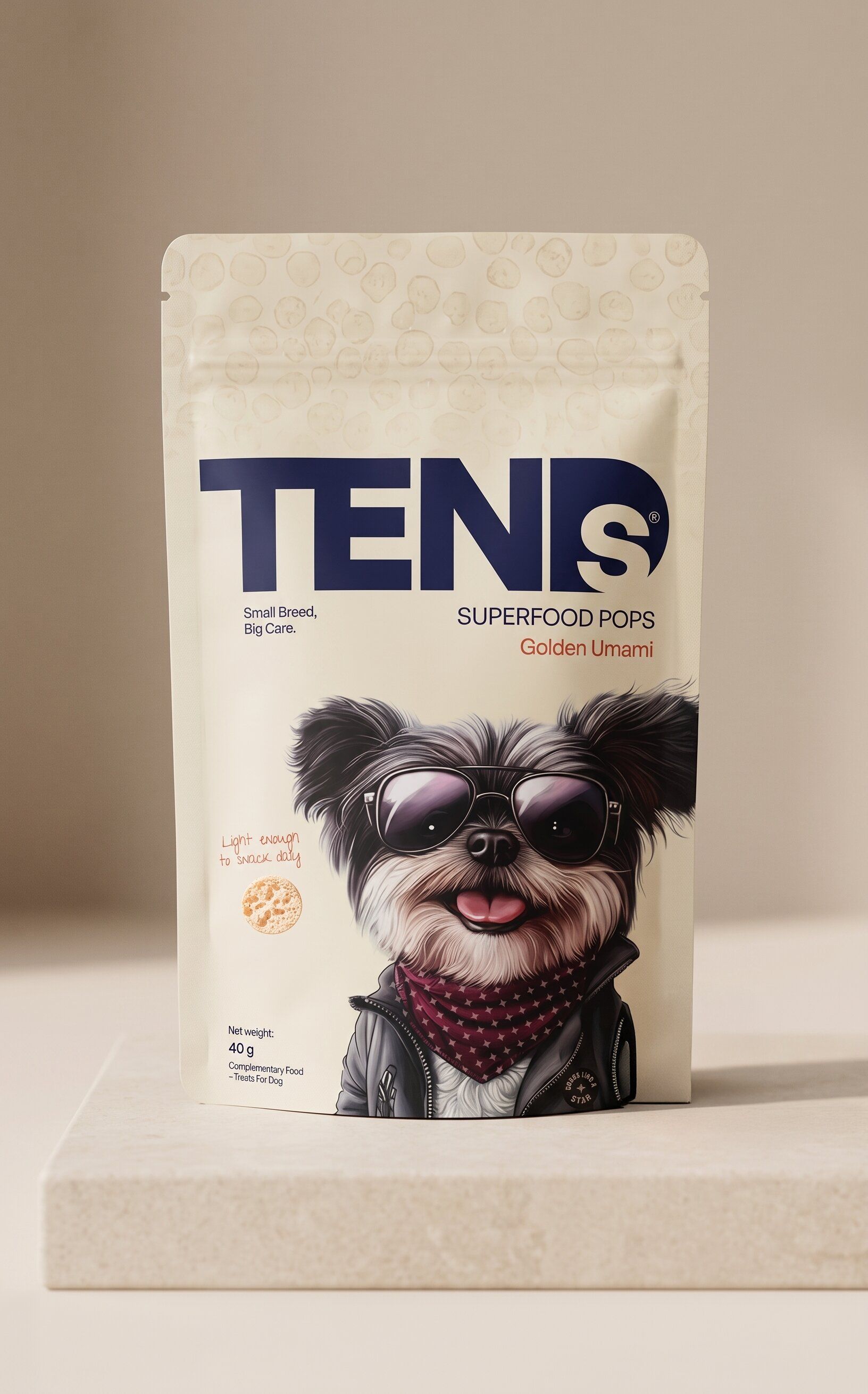
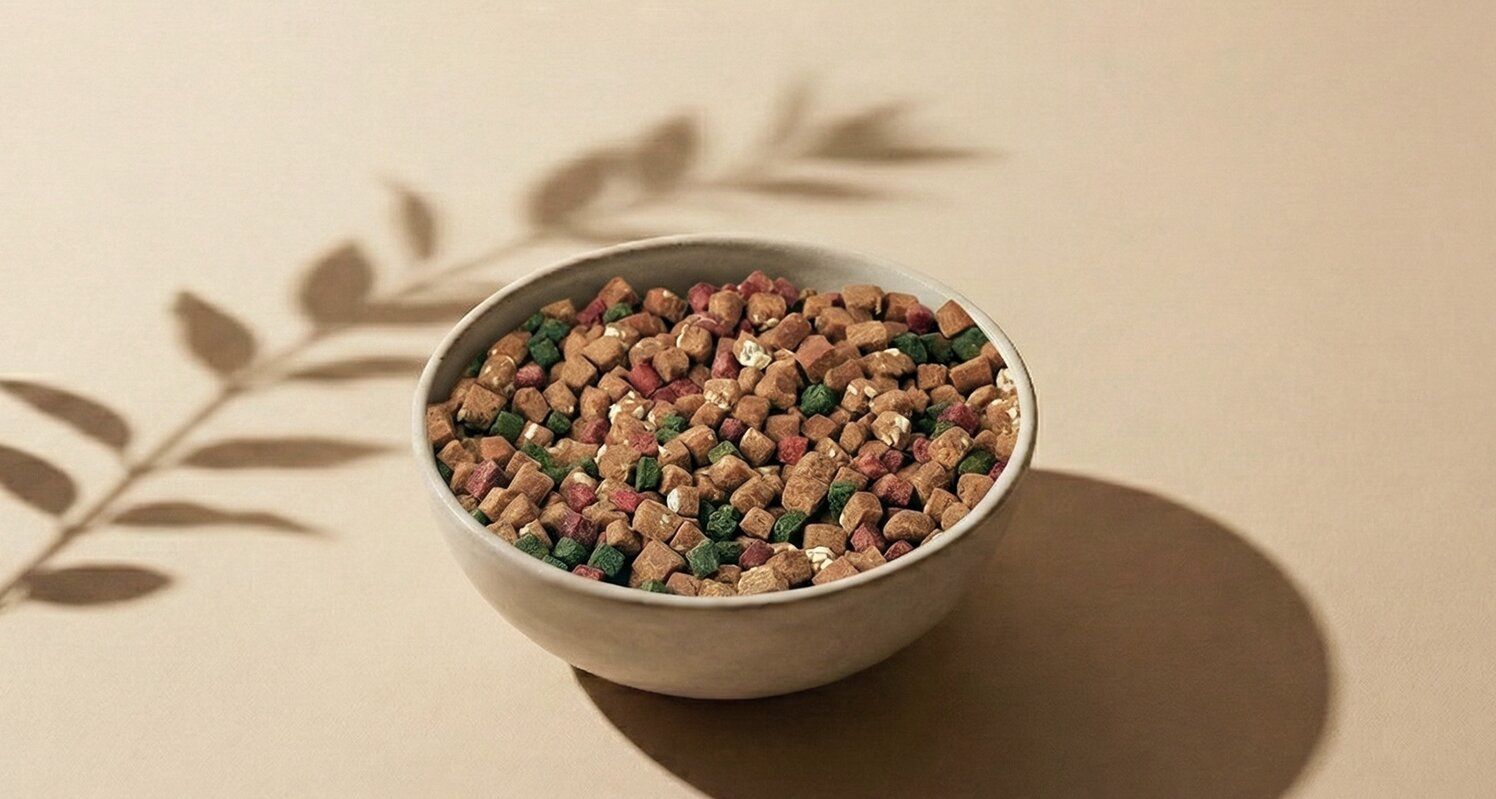
The Superfood Blend is built for the smaller mouth and the narrow margins a toy breed runs on: small kibble, calibrated calorie density, ingredient balance designed to work inside a 60-to-180-gram day. Superfood Pops are built for the structural treat math — light by nature, calorically honest, the kind of treat the day can carry several of. Less to work with. More riding on it.
The chart is the starting point. The body completes the read.
Feeding a toy breed sounds harder than it is. The math is real, and the math is in the kilos. The cliché is a story; the curve is measurement. The brand a toy-breed parent earns is the one that names what the research has settled and what it hasn’t, and that hands the rest back. Every bite is a decision because there are fewer of them. The math is where you start.
Read the dog. Not the chart.
Sources
1. Divol O, Priymenko N (2017). A new model for evaluating maintenance energy requirements in dogs: allometric equation from 319 pet dogs. Journal of Nutritional Science, 6, e44. https://doi.org/10.1017/jns.2017.43 2. Burger IH, Johnson JV (1991); Bermingham EN, Thomas DG, Cave NJ, et al. (2014). Dogs large and small: the allometry of energy requirements within a single species. Journal of Nutrition, 121(11 Suppl), S18–S21 (PMID 1941223). Also: Energy requirements of adult dogs: a meta-analysis. PLOS ONE, 9(10), e109681. https://doi.org/10.1371/journal.pone.0109681 3. van Toor AJ, et al. (1991); Fuchs et al. (2024). Experimental induction of fasting hypoglycaemia and fatty liver syndrome in three Yorkshire terrier pups. Veterinary Quarterly, 13(1), 16–23 (DOI 10.1080/01652176.1991.9694280). Also: Neonatal hypoglycemia in dogs — pathophysiology, risk factors, diagnosis and treatment. Frontiers in Veterinary Science, 11, 1345933. https://doi.org/10.3389/fvets.2024.1345933 4. Morgan RK, Cortes Y, Murphy L (2018). Pathophysiology and aetiology of hypoglycaemic crises. Journal of Small Animal Practice, 59(11), 659–669. https://doi.org/10.1111/jsap.12911 5. Nii et al. (2024). Hypoglycemia after mitral valve repair in dogs. Veterinary Sciences, 11(2), 79. https://doi.org/10.3390/vetsci11020079
Written by the TENDS Nutrition & Research Team
Built within the TENDS small-breed formulation and behavioural framework


Big Brand? No.
A Smaller One — On Purpose.
Stay close for bold new moves in small-breed care.
RESET