The 4am yellow bile problem (and why it usually isn’t food)
It’s somewhere around 4am. She retches twice. Yellow foam, sometimes a little fluid. She’s quiet again in a minute, eats breakfast like nothing happened — and the bowl at 7pm last night was perfectly normal.
If you’ve been there, you’re not imagining it — and the food usually isn’t the issue. The yellow is bile, the timing is empty-stomach, and the answer is more often math than mystery.
Why does my small dog throw up yellow bile at 4am?
Empty-stomach math, not a food problem. By 4am the 7pm dinner has long since cleared. Bile keeps releasing on its normal cycle and some of it backs up into an empty stomach; the lining doesn’t like it; the stomach contracts to clear the irritation. Vets call it bilious vomiting syndrome. Most of the time it’s got nothing to do with what’s in the bowl — the bowl just emptied too long ago.
What stops the 4am bile vomit?
A small bite at bedtime — twenty or thirty calories — closes the empty-stomach window before 4am arrives. Most dogs respond inside a week. The fix is mechanical, not nutritional: shorten the gap. Splitting the day’s portion into more meals or adding a third small late-evening offering both work. The total daily calories don’t change. The way you spread them out does.
Is the food causing my dog’s morning bile vomit?
Usually not. What’s underneath the pattern is timing, not what’s in the food — a small stomach plus a long gap plus the regular bile cycle the body runs anyway. Recurring vomiting, blood, lethargy, or vomiting that doesn’t respond to the bedtime-bite reset is vet territory. Otherwise the food is rarely the lever; the timing is.
What’s actually happening at 4am?
A small dog’s stomach holds less. The 7pm dinner is digested in a few hours. By 4am, the stomach is empty — and has been for a while.
When the stomach is empty for a long stretch, the body doesn’t pause digestion. Bile keeps being released into the duodenum on its normal cycle, and some of it can back up into the empty stomach. Bile is acidic; the stomach lining doesn’t like it. The stomach contracts to clear the irritation. The dog retches. The yellow you see is the bile that was never meant to sit there. This is the same thing vets call bilious vomiting syndrome, and most of the time it doesn’t mean there’s an underlying disease. It takes three things together: a small stomach, a long gap between meals, and the regular bile cycle the body runs anyway¹.
It’s worth noticing what isn’t on that list. The food itself. The brand. The protein. The recipe. Most morning-bile cases have nothing to do with what’s in the bowl — the bowl just emptied too long ago.
There’s a related pattern worth naming so you don’t mix the two up. The 9pm hunger that often comes alongside — the dog who suddenly seems ravenous in the late evening — is the same math from the other end. Both are the empty-stomach window showing up. Both go away when the gap closes.
What fixes it?
The fix is mechanical, not nutritional. You shorten the gap.
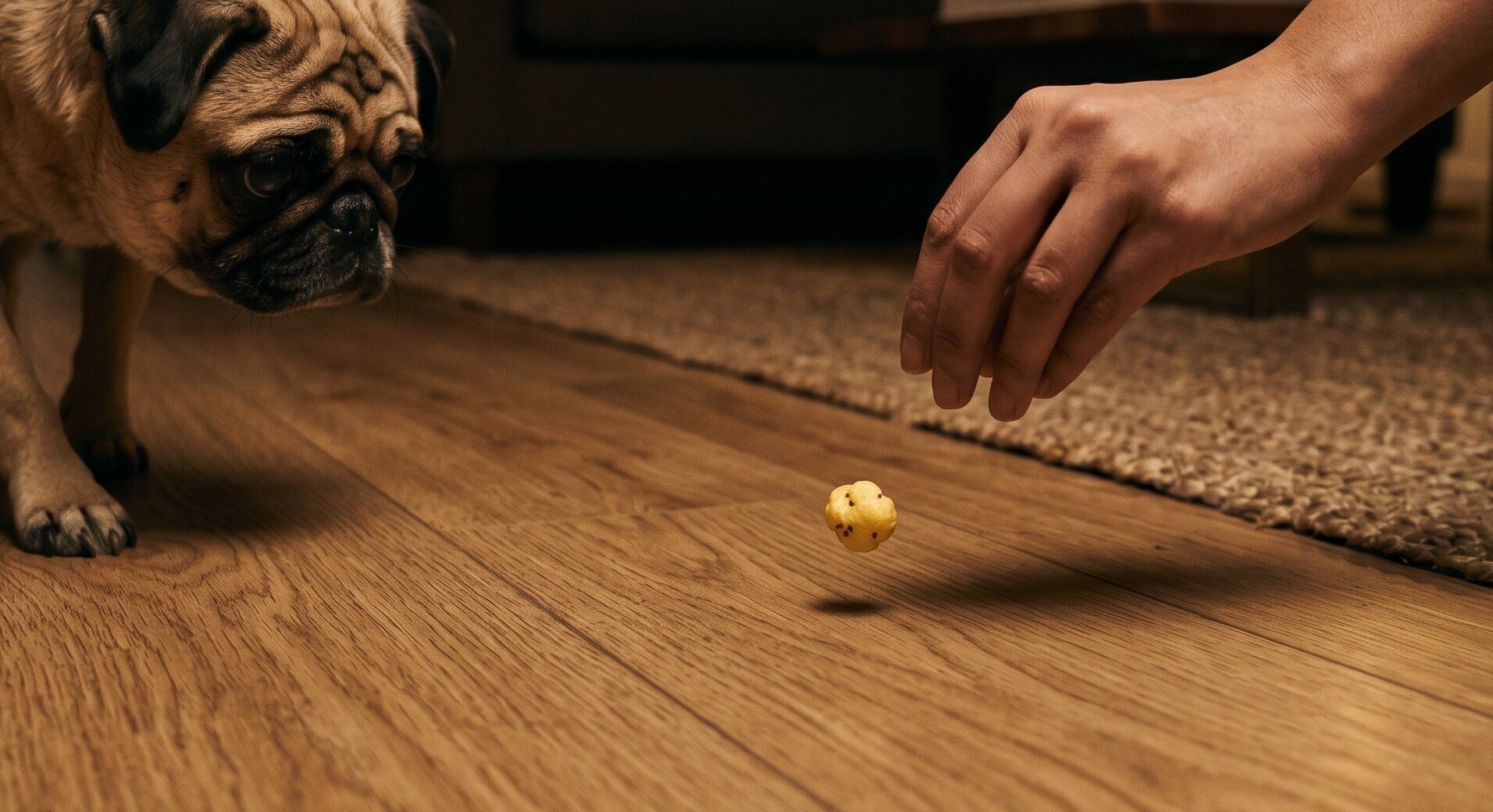
A small bite at bedtime — twenty or thirty calories’ worth — closes the empty-stomach window before 4am arrives. Most dogs respond inside a week. A teaspoon of her regular food, a small piece of Superfood Pops, or anything light enough not to sit heavy. The point isn’t volume. It’s keeping the stomach from running on empty for ten hours.
If once-a-day feeding has been the schedule, splitting the day’s portion into two meals (morning and evening, with the evening one timed late) often sorts it out without adding anything new. If twice-a-day is already the pattern, adding the bedtime snack as a third small offering is the simplest move. The total daily calories don’t change. The way you spread them out does.
Three things worth holding onto.
First — this is what parents are already doing, not TENDS protocol. Owners on Cavalier forums, Chihuahua forums, and Poodle forums landed on the same fix on their own. The biology underneath is what makes it work every time; the fix itself comes from people who tried it and watched it work.
Second — the reset takes a few days. The first night you might do everything right and still see the bile. The body is on a rhythm; rhythms take a beat to adjust. By night four or five, most dogs are quiet through the morning.
Third — if the morning bile looks different (more often than once a week; happening at all sorts of times; coming with lethargy, blood, or pain; or in a puppy or senior with other signs running alongside), the math reading isn’t the right first read. That’s a vet visit, and it’s the right place for it. This holds for the steady, predictable, otherwise-well dog with the 4am pattern.
What changes next time
The next time it happens — and there might be one more time before the schedule resets — you’ll know what you’re seeing. Yellow foam, twice, then quiet. The bowl at 7pm wasn’t the problem. The 4am gap was.
It was math, not behaviour. Read the dog. Not the chart.
Sources
1. Washabau RJ, Day MJ (eds) (2013). Canine and Feline Gastroenterology. Saunders Elsevier (Chapter 36 — bilious vomiting syndrome).
Written by the TENDS Nutrition & Research Team
Built within the TENDS small-breed formulation and behavioural framework


Big Brand? No.
A Smaller One — On Purpose.
Stay close for bold new moves in small-breed care.
RESET