What goes in when chicken comes out — what plants can deliver to a small body
If you’ve been told to take chicken out, the next question — what should go in — is the part the bag won’t answer. The list of “limited-ingredient” foods is long, and most of them just swap one animal protein for another. That works for some dogs. For others, it doesn’t.
The swap often fails because the original problem isn’t always the chicken. It’s her body reacting to a protein it’s met too often, in too many forms.
Here are the two halves of it, out loud. There’s real evidence underneath the plant-protein answer: a twelve-month controlled feeding trial that kept adult dogs’ clinical health markers steady¹; a systematic review that doesn’t show consistent harm from well-formulated plant-based diets in dogs². And there’s the small-dog-specific part: those studies show plant food is enough for dogs in general; what TENDS argues is how it fits the smaller intake.
What should I feed my dog if chicken is out?
The answer the bag won’t give you cleanly is that the protein has to change, and so does the way her body meets it. Hydrolysed and novel-protein diets are the standards vets use for trials³. For feeding past the trial, the question stops being which animal — and starts being whether the new protein is well-digested, gentle on her immune system, and dense enough for a small-dog bowl to carry the day.
Are plant-based diets safe for small dogs?
Yes, when the food is well made. Dogs are built to eat both meat and plants, and they use amino acids no matter where the protein comes from. A peer-reviewed twelve-month controlled feeding trial kept clinical health markers and amino acid status steady across the year. A 2023 systematic review doesn’t show consistent harm from well-formulated plant-based diets in dogs. What matters is how the food is made, not which category it’s in. The small-dog part is whether the food fits the smaller intake.
Are dogs carnivores? Don’t they need meat?
No. Living alongside us shifted dogs toward digesting starch. The genetic change is on record — dogs carry far more copies of the AMY2B amylase gene than wolves do⁴. Dogs aren’t wolves, and they aren’t built to eat meat only. By their genes, they eat both. What they need is amino acids, fatty acids, and the rest of the nutrient set; where the food draws those from is a question of how it’s made.
Is plant protein really as good as animal protein for dogs?
It can do the same nutritional work when the food is built for it. In a controlled feeding trial, plant protein matched animal protein for how well it was digested⁵. The amino acids that arrive at the cell don’t carry where they came from. Her body uses what it gets, not where it came from. Better is the wrong question — the brand’s claim is that well-formulated plant protein is right for dogs, and especially for the small-dog system where every gram has to count.
What plants can deliver
Protein is a question of delivery, not of where it came from. Her body uses amino acids — twenty of them, ten of which a dog can’t make and has to get from food. Plants carry those ten. So does meat. So does egg.
What changes from one source to another is how well it’s digested: how completely the protein breaks down and how cleanly the amino acids reach her body. In the twelve-month controlled feeding trial, a commercial plant-based diet kept measured plasma amino acid status steady across the year⁶. The systematic review doesn’t show consistent harm from well-formulated plant-based diets⁷. The delivery worked.
That’s why “plant-based” and “animal-based” are the wrong way to frame it. The question isn’t which kind of food. The question is what arrives at the cell, how cleanly, and how much. Both halves of the category can deliver well, when the food is built for them. Both halves can deliver poorly when it isn’t. Where it came from is a side fact. Delivery is the main one.
The amino acids don’t carry their origin.

What the answer has to do
When the protein has to change, the question stops being which animal it came from. Her body doesn’t taste protein the way the tongue does — it works through amino acid sequences, breaks them down, takes in what it needs. The new protein has to clear three things. Digestibility: it breaks down cleanly enough that her body gets the amino acids without leaving behind residue the gut has to deal with. Gentle on her immune system: it doesn’t set off the same reaction the old one did. Density: dense enough that a small dog’s bowl can carry the full day’s nutrition in a smaller intake.
Plant proteins clear all three when the food is built for them. Pea, lentil, fava, hemp, sunflower: you get the full set of amino acids by combining them, not from any single plant alone. How well it’s digested comes from the cooking. Density comes from the design — calorie concentration, the balance of protein to fat, and tuning the ingredients to the smaller intake.
The move here is the move her body makes anyway. The protein changed; the system receiving it didn’t. What holds across the change is whether the new protein still does the job.
Built for the smaller intake
The general-dog evidence is real: well-formulated plant-based diets meet what dogs need across the body of studies. That’s what the systematic review concludes. What sits right next to that — what TENDS specifically argues — is that being enough for dogs in general needs translating for the small-dog system, where the smaller intake makes density the bottleneck and every gram has to do more.
A small dog’s bowl carries 60 to 180 grams of food a day, depending on her weight and how active she is. Inside that small amount, what goes in has to deliver the full day’s amino acids, the full set of fatty acids, the vitamins, the minerals, the fibre. There’s no room for ingredients that work in bigger dogs but don’t pack down well into a small-dog day. Less to work with. More riding on it. A note on a worry that goes around. The taurine and heart-disease concern that’s come up around plant-based dog food is one most parents have read about. The twelve-month controlled feeding trial included heart markers and showed no harm; the systematic review doesn’t show consistent heart harm from well-formulated plant-based diets. The published concern about heart disease in dogs has centred on grain-free foods heavy in legumes like peas and lentils — a question of how the food is made, not which category it's in. Well-formulated is the line, and that’s the line every plant-based recommendation rests on.

How to read what’s working
Five things to hold onto. Not a schedule. The schedule belongs to the calendar; these belong to the chain.
Give it time. A protein change is a gut conversation that takes weeks to months, not days. Don’t decide at three days. Don’t decide at three weeks if the other signs haven’t started moving. Her body keeps no record of the bag — only of what arrived, and how long it kept arriving.
Watch a few things at once. Skin, stool, energy, coat: read them together over weeks. A change that shows up in one of them alone tells you less than a change that shows up in three. You can read it clearly at the three-month observation window, the observation primer walks through.
Hold to whether it delivers, not the source story. The question is whether the new protein delivers — well-digested, gentle on her immune system, dense enough. Not whether it came from chicken or pea or lentil or microalgae. Where it came from is the marketing question. Delivery is her body’s question. Hand acute or alongside signs to the vet. A sudden change, lesions, symptoms that keep coming back, tiredness that runs alongside the food trial — that’s a conversation for the vet first. The food trial catches the slow trend; the vet handles what the trend turns up.
Read what her body says back over weeks. Dogs need nutrients, not ingredients. The bag’s marketing language is one way of looking at it; what her body actually does with the food is another. The second one is what tells you whether the food is working.
What that looks like in TENDS’ system
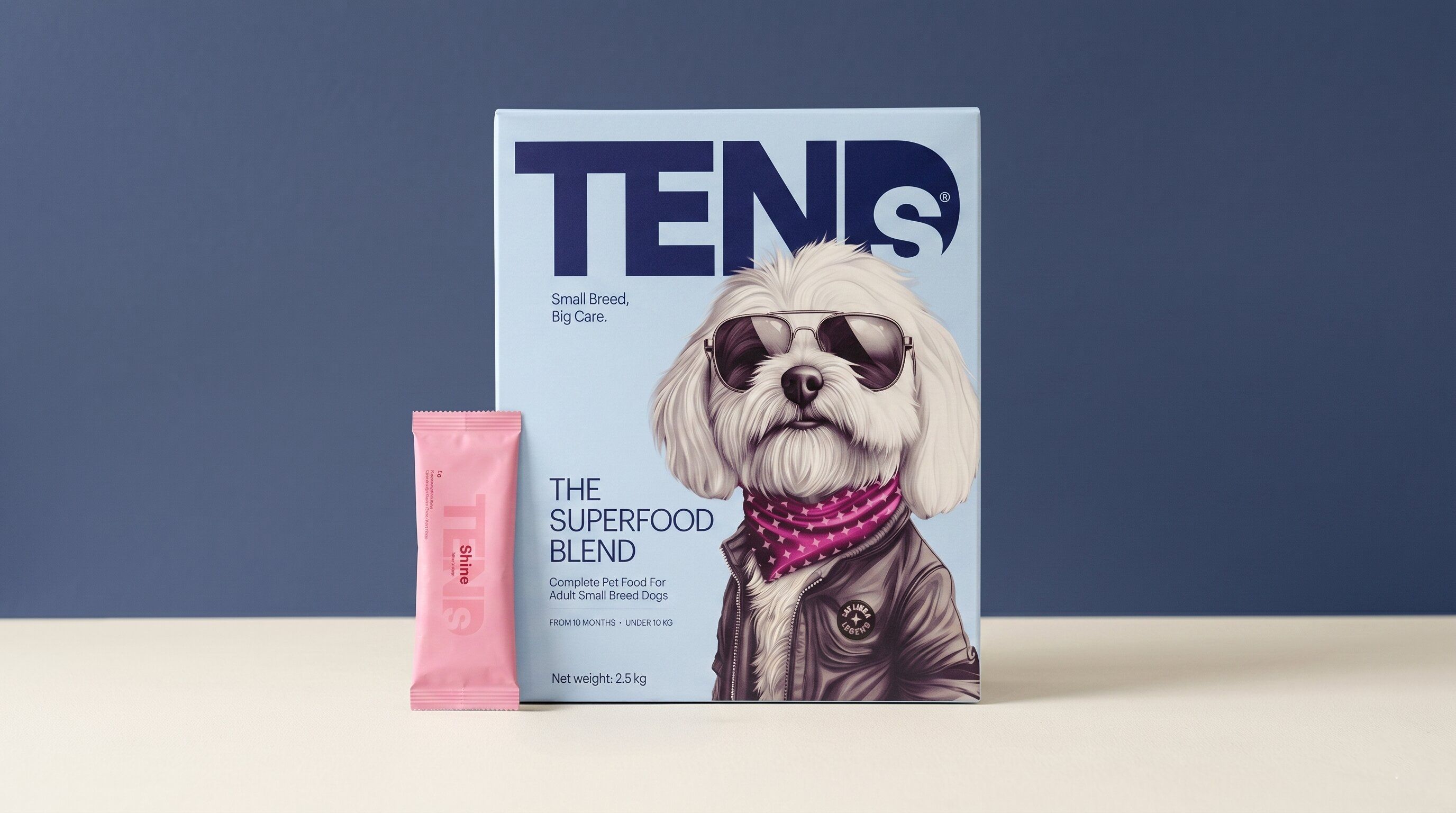
The Hydration Ritual SHINE blend and the Superfood Blend both deliver DHA from microalgae — held inside the algal cell wall rather than pressed out as oil. Whole-cell biomass form. No added antioxidants needed; the cell wall does the protecting. The Superfood Blend’s protein is built around plants because the small-dog constraint, the digestibility math, and the delivery-not-origin frame all point that way — not because plant is better, but because what fits inside a smaller intake matters more.
Built around what a small body can carry
What you’ve been working through — chicken out, what now — has an answer that doesn’t need to come from the category fight. What the new food has to meet is delivery, not where it came from. The amino acids her body uses don’t carry their backstory. The smaller intake makes that sharper, not different.
Built around what a small body can carry — and what it can use.
Eats it. Absorbs it. Uses it.
Sources
1. Linde A, Lahiff M, Krantz A, Sharp N, Ng TT, Melgarejo T. (2024). Domestic dogs maintain clinical, nutritional, and hematological health outcomes when fed a commercial plant-based diet for a year. PLOS ONE, 19(4), e0298942. https://doi.org/10.1371/journal.pone.0298942 2. Domínguez-Oliva A, Mota-Rojas D, Hernández-Ávalos I, et al. (2023). The impact of vegan diets on indicators of health in dogs and cats: a systematic review. Veterinary Sciences, 10(1), 52. https://doi.org/10.3390/vetsci10010052 3. Olivry T, Bizikova P (2010). A systematic review of the evidence of reduced allergenicity and clinical benefit of food hydrolysates in dogs and cats. Veterinary Dermatology, 21(1), 32–41. https://doi.org/10.1111/j.1365-3164.2009.00761.x 4. Axelsson E, Ratnakumar A, Arendt M-L, et al. (2013). The genomic signature of dog domestication reveals adaptation to a starch-rich diet. Nature, 495(7441), 360–364. https://doi.org/10.1038/nature11837 5. Roberts LJ, Oba PM, Swanson KS. (2023). Apparent total tract macronutrient digestibility of mildly cooked human-grade vegan dog foods and their effects on the blood metabolites and fecal characteristics, microbiota, and metabolites of adult dogs. Journal of Animal Science, 101, 1–14. https://doi.org/10.1093/jas/skad093
Written by the TENDS Nutrition & Research Team
Built within the TENDS small-breed formulation and behavioural framework


Big Brand? No.
A Smaller One — On Purpose.
Stay close for bold new moves in small-breed care.
RESET