What good post-bowl data looks like — building a daily-baseline before anything has gone wrong
You’ve been doing this already. Quietly, every day, often without calling it anything — checking the bowl, the floor, the water level, the coat, the way she moved across the room this morning compared with last week. What you’ve built without writing it down is a baseline.
What matters most isn’t what the vet sees in a twelve-minute appointment. It’s what you see across weeks. Watching her every day is what makes the next thing readable.
Here’s the way to do it — what good post-bowl data looks like, why it matters, how to build it. The idea is to get ahead of trouble: build the baseline before anything has gone wrong, so when something does, you’ve got something to compare against. This sits alongside what the vet handles in the appointment, not instead of it.
What should I be observing about my dog every day?
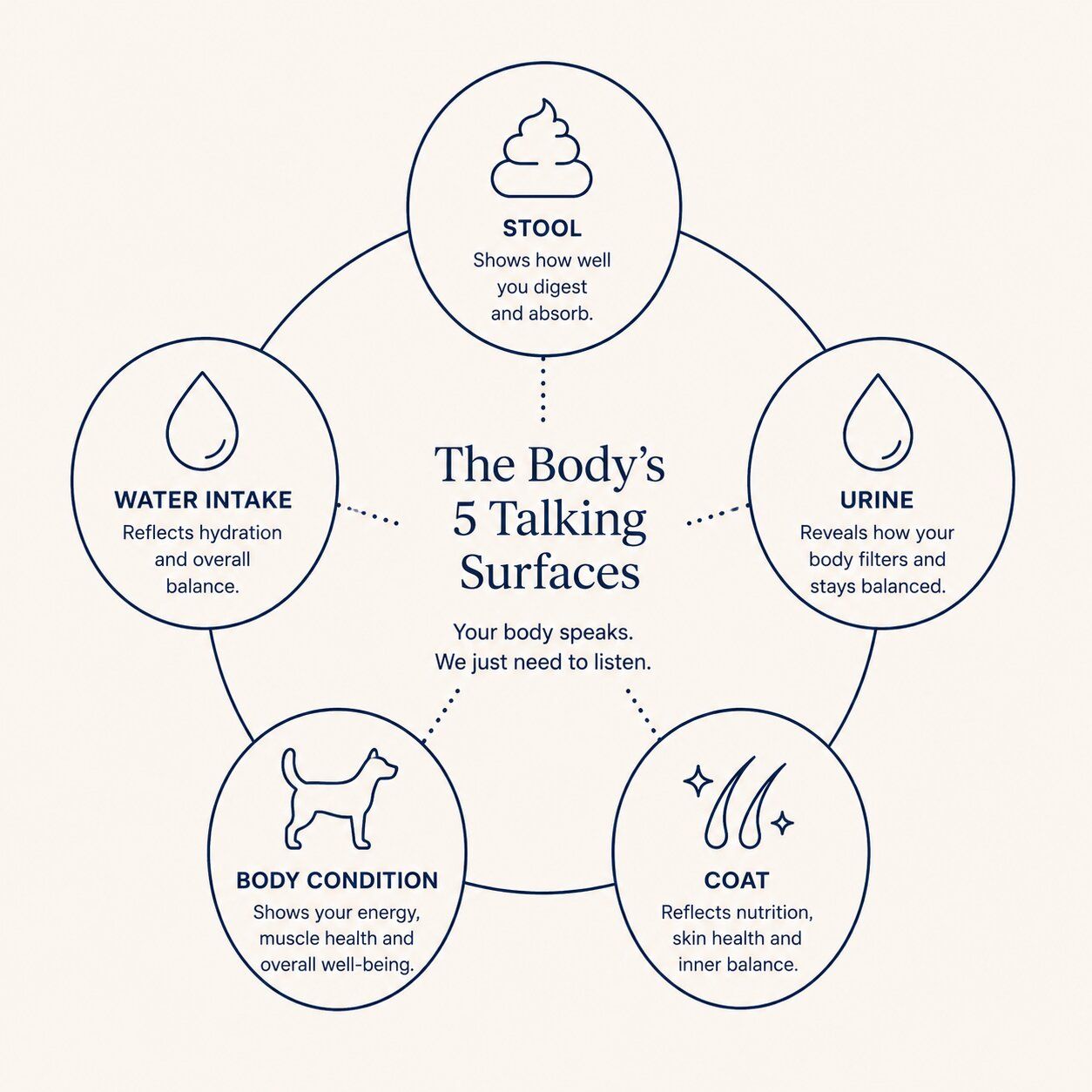
Five things, looked at in passing rather than tracked in spreadsheets: her poo — how it looks and how often; how she wees; how much water she drinks; her body; her coat. Each one shows you something the others can’t, and the pattern across all five — over weeks, not over a single day — is what catches a drift before the drift becomes a problem. It’s not about looking hard. It’s about looking steadily. A light look every day beats one exhaustive look a month.
How do I know what is normal for my dog?
You build it by watching. There’s no general “normal” the chart can hand you for your specific dog at your specific weight, age, life stage, and household. What there is, is her normal — the poo her gut makes on her food; the water she drinks across her ordinary day; the coat at month two on her current diet. Normal is what you have once you’ve been looking long enough to notice when she drifts from it. Two to three months of unhurried watching is when her baseline becomes clear.
What does my dog’s stool / urine / water intake actually tell me?
Each one shows you a different layer. Her poo shows you digestion and how well her body’s using the food — what her gut did with what arrived. Her wee shows you kidney function, how hydrated she is, and a little of what her body’s burning. How much water she drinks shows you the whole-body side of her water — how she’s regulating, not how her skin or coat is reading. The whole-body side and the surface side are biologically different, and reading them apart is most of what this is about.
How long should I observe before deciding something has changed?
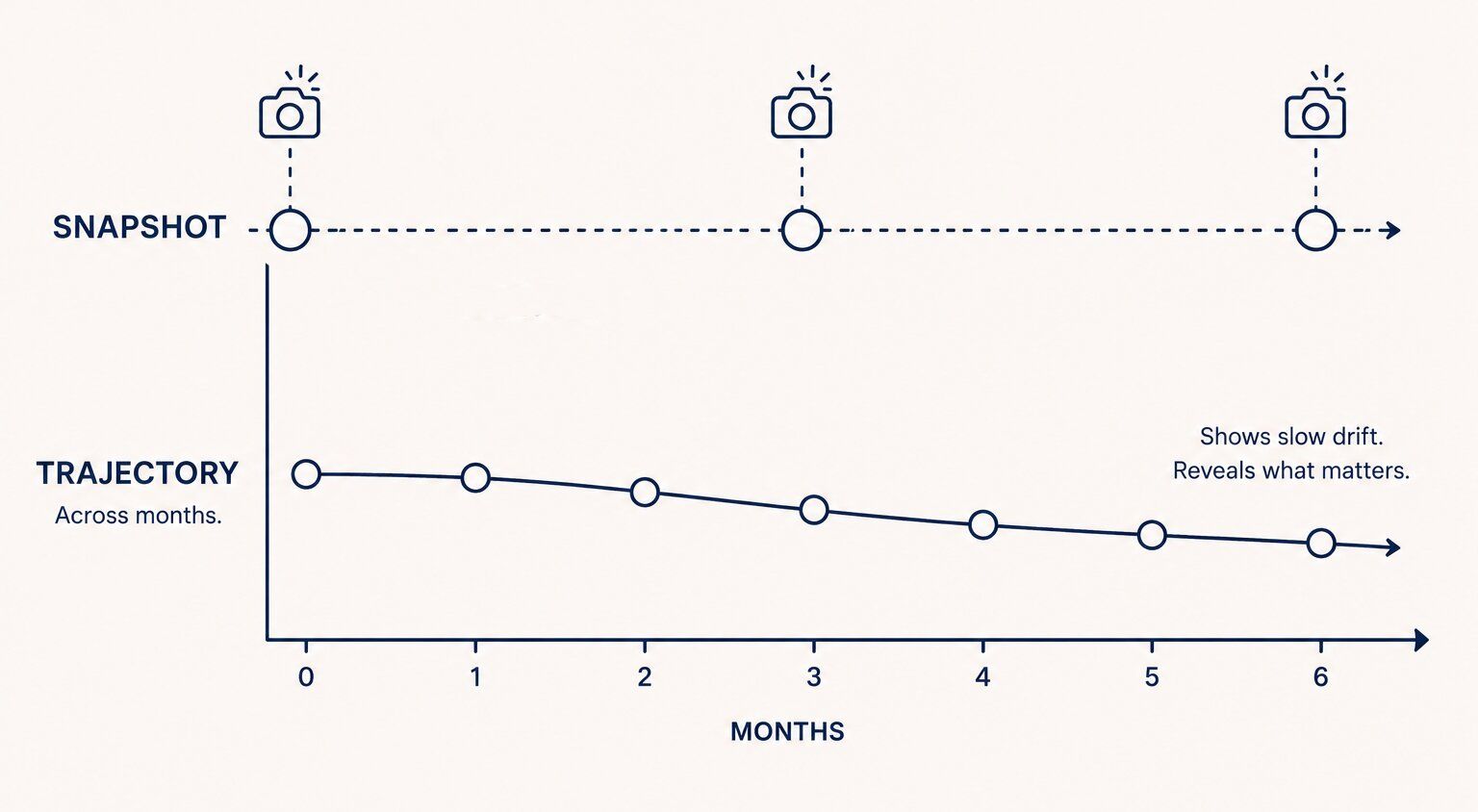
Weeks, not days. The trajectory becomes clear at a three-month window, and real change usually takes four to six weeks to show. The daily look is for noticing; the weekly note is for catching drift; the month-to-month comparison is what shows you the trajectory the daily eye misses. Read too early and you read what hasn’t arrived yet. The body talks on the body’s own clock.
What to actually observe
Stool. Consistency, colour, how often, anything undigested, mucus, blood. How well her body’s using the food sits here — what her gut did with what arrived; what crossed the gut wall and what didn’t. Look in passing on the daily walk. The change to watch for is drift from her baseline, not drift from a chart.
Urine. How often, what colour, how much against how much she drank. Pale and frequent reads differently from concentrated and infrequent; the meaning is in how it relates to what went in. It’s a passing look, not a measurement. Water intake patterns. When she drinks, how much, whether it bunches around meals or runs across the day on its own. A sudden change in the pattern tells you more than the total amount — bodies drink to need, and her baseline is what her body settled on.
Body condition trajectory. The month-to-month shift the bathroom scale misses. Run your hands lightly along her ribcage, look down at her waist, look at the tuck behind the ribs. What you see and what you feel, together, catch what the scale rounds off — especially at small body weights, where a half-kilo movement is a lot.
Coat. A month-to-three-month read; the slowest thing on her body to show. The keratin growing through right now reflects what her body was doing six to twelve weeks ago. The photo-comparison practice covers this in full; here, the coat is one of five things you’re watching.
The body is talking. The data is what hears it.
Reading hydration: what water tells you, and what it doesn’t
Water is where most parents over-read or under-read. The whole-body side of water and the surface side are biologically different, and reading them apart is what makes this useful instead of alarming.
Systemic hydration is what how much she drinks tells you. The water she drinks travels through the gut, into the blood, through the kidneys, to the muscles, to the cells that need it. In small dogs, water cycles through faster relative to body size, because it tracks energy. When she drinks more or less than her baseline, what’s shifting is the whole-body side.
Local hydration is what her skin, coat, and tear stains tell you. The surface is run by the barrier, the sebum film, the local microbiome, the environment — not by how much water she drank yesterday. Drinking more usually doesn’t fix dry skin; that’s a claim that walks right past where dry skin actually lives. The surface is its own read.
So hold the two apart. When how much she drinks shifts, look at the whole-body side. When her skin or coat shifts, look at the surface. Sometimes the two move together — a whole-body illness can show up at both — but often they don’t. Watch the margin, not the dog.
Why baseline matters
A snapshot with no baseline is a number with no context. A baseline with no snapshot is a record with no moment. You need both — and the trajectory across the pair is what catches the drift the daily eye misses.
The vet who sees the dog twice a year reads the snapshot. She’s good at it; that’s the work the appointment does. The parent who sees the dog every day reads the trajectory. Both are real, and both matter; the trajectory is the one that’s yours. Less is what gets noticed first — the dullness today, the slightly looser poo, the half-empty water bowl that used to be empty by evening — but the comparison across months is what shows you what’s actually moving. Watching across three time-spans at once holds three things together: the daily look (catching the moment); the weekly comparison (catching the drift); the month-to-three-month look (catching the shift). Each one misses what the other two catch. So keep all three going.
Baseline is what becomes data when something changes.
How to actually do this
Five things to hold onto. Not a schedule. The schedule belongs to the calendar; these belong to the watching.
Look every day; note once a week. The daily look is for noticing, not for journaling. A weekly note — three lines, on your phone — is enough to catch drift across months. The writing is light; the looking is the work. Take a photo once a month. A photo from above, same light, same time of day, once a month. After three months, lay them side by side. Your eye is tuned to yesterday; the photo is tuned to the comparison. The photo-comparison practice covers this in full.
Trust the trajectory over the moment. One day of looser poo isn’t anything yet. Three weeks of slightly looser poo is. What you’re reading lives at the trajectory; the single moment sits below it. The three-month observation window covers how the trajectory becomes clear.
Hand the sudden or alongside stuff to the vet. A sudden change, sores, symptoms that keep coming back, tiredness running alongside the drift — that’s a vet conversation first. You catch the trajectory; the vet handles what the trajectory turns up. Both work together; neither replaces the other. The body-condition primer covers the same line.
Watching the margin is quiet attention, not a checklist. Calm daily looking, not anxious ticking-off. The parents who do this best aren’t tracking everything; they’re watching steadily. Consistency does more than intensity.
What that looks like in TENDS’ system
The Hydration Ritual sits at the whole-body side of all this — her water made readable across days, not the surface. The Superfood Blend sits at the post-bowl side — what her gut returns reads what arrived. TENDS Touch sits at the surface-care side, separate from the whole-body read. The brand reads what the body talks through; the products are tools for parents who are already reading.

What you have been doing already
What you have been doing — quietly, daily, without naming it as practice — is the practice. The methodology only formalises what your attention has already been gathering. Look every day. Compare across weeks. Read the trajectory. The baseline is the most useful thing you will ever have, and it is the thing you can only build before anything has gone wrong.
Read the dog. Not the chart.
Written by the TENDS Nutrition & Research Team
Built within the TENDS small-breed formulation and behavioural framework
Read next


Big Brand? No.
A Smaller One — On Purpose.
Stay close for bold new moves in small-breed care.
RESET