What three months of photos tell you the day-to-day misses
A parent on a destination shih tzu forum looked back through old photos one afternoon and realised her dog’s tear stains had been worse than she’d remembered. I didn’t remember how bad they were — and parents say a version of that all the time. The same thing happens with coat changes once you put the photos side by side: the dog at month three doesn’t look like the dog at month zero, and you’d lost the comparison.
The coat speaks at month-scale, not at day-scale. The eye is calibrated to yesterday; the photograph is calibrated to three months ago. Here’s what three months of photos actually show you about the coat — and what the comparison can’t tell you.
How do I tell if my dog’s coat is changing?
Photograph her once a month, same lighting, same angle, same time of day. After three months, lay them side by side. The coat speaks at month-scale, not at day-scale — the keratin growing through right now reflects what her body was doing weeks to months ago. The eye is calibrated to yesterday; the photograph is calibrated to three months ago. The two readings catch different things.
Why do I keep missing slow changes in my dog?
Your eyes are tuned to spot change against a background, not slow drift in the background itself. Each day’s look sits inside yesterday’s tolerance. By the time today’s eye notices anything, the baseline has already moved a fair way. This isn’t a failure of attention. It’s how attention works. The friend who hasn’t seen the dog in eight months notices the second they walk in, because their eye was set to autumn — not to last week.
What should I photograph each month?
An overall shot from above (back and flanks); a side shot showing the topline and tuck; the spots where the coat tends to shift first — the back where some breeds thin gradually, the belly where density and pigmentation change, around the collar where wear shows, the tail base where breakage starts. Different breeds tell you in different places. A few months in, you’ll learn which spots your dog speaks through.
What does the coat actually report?
The coat reads what her body has been carrying through over months. The keratin growing through it right now reflects what her body was doing weeks to months ago. The shine that’s coming back is responding to what her system has been delivering for a while. The fill-in or the thin-out you’d half-noticed is the surface working with what arrived.
In some dogs, this connects to how well her body uses the food — the coat as a readout of the third stage of nutrition (what her body did with what got across). The connection isn’t always neat, and it isn’t every dog. But often enough to be worth listening for.
Daily looking can’t read this. The change is too slow to register against yesterday’s baseline — the same thing the signal-normalisation primer walks through. What the eye needs is the comparison the eye doesn’t naturally have.
One honest note before you start: coat changes don’t all trace back to food or to what’s going on inside. The coat also responds to season (the spring and autumn coat-blowing cycles), to age (texture and density shift through her life), to hormonal cycle (in unspayed females), to skin care (bath frequency, products, environment), and to what she’s exposed to (sun, heat, friction). Not all coat change means food change. Comparing photos shows you the change; what the change traces back to is a separate read.
What does the comparison actually surface?
A photograph of your dog’s coat once a month. Same lighting if you can hold it, same angle, same time of day. Phone camera is fine — what matters is staying consistent, not the equipment.
What to photograph at the coat level: an overall shot from above (back and flanks); a side shot showing the topline and the tuck; the spots where the coat tends to shift first — the back where some breeds thin gradually, the belly where coat density and pigmentation can change, around the collar where wear shows, the tail base where breakage sometimes starts. Different breeds tell you in different places; over a few months, you’ll learn which spots your dog speaks through.
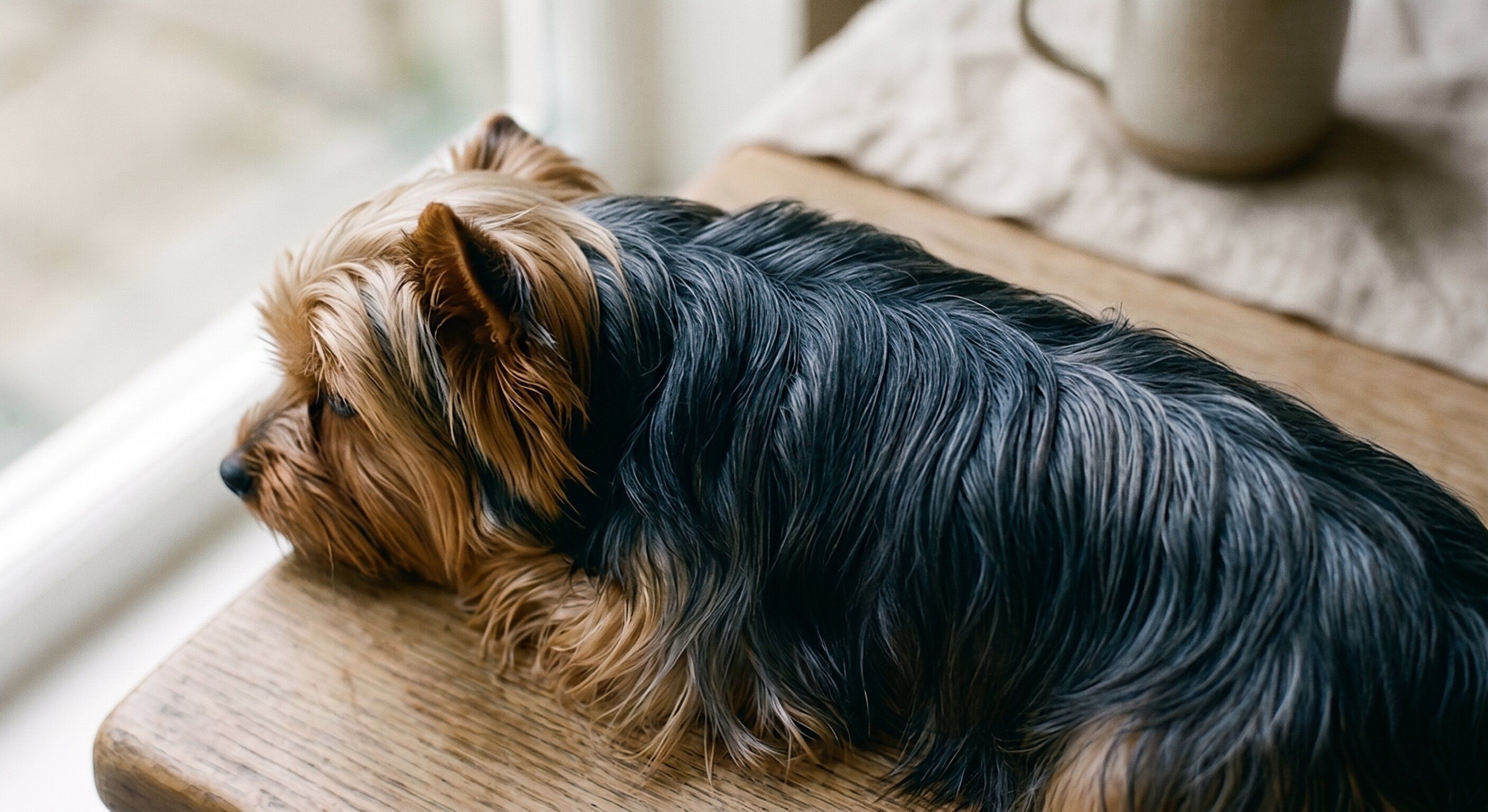
This is what parents are already doing, not a TENDS invention. What matters is staying consistent over weeks; the substance is the comparison.
What three months actually show you: gradual fill-in or thin-out you didn’t notice day to day; shine that’s come back (or hasn’t) since the food change you’d half-forgotten about; texture change that wasn’t visible in a single day; pigmentation drift that surfaces once you compare across the window. The dog at month three doesn’t look much different from the dog at month two. The dog at month three, next to the dog at month zero, shows the change in daily looking couldn’t hold.
If the comparison turns up something sudden — a quick change between two consecutive months, signs running alongside the coat (tiredness, a shift in behaviour, symptoms that keep coming back) — that’s a conversation for the vet. Photographing her catches the slow change; the vet handles what that change turns out to be.
Where TENDS sits in this question
Photographing her has its own value whether or not it points to any one product. The surfaces the photos read sit at three layers TENDS works across: Superfood Blend on the inside (what the coat is reading at the whole-body layer); Hydration Ritual SHINE on the inside (the whole side of skin and coat); TENDS Touch on the surface (where moisture, friction, and contact happen). You earn the connection if it’s there to make.
What three months gives back
The dog at month three isn’t a different dog. The eye at month three has different information.
Less is what gets noticed first. Read the dog. Not the chart. The comparison gives you back the slow change daily looking couldn’t hold.
Written by the TENDS Nutrition & Research Team
Built within the TENDS small-breed formulation and behavioural framework


Big Brand? No.
A Smaller One — On Purpose.
Stay close for bold new moves in small-breed care.
RESET