You can grade a food on outputs — what your dog’s stool is telling you about her food
A frenchie owner on a forum said she figured out whether her dog’s food was working by what was coming out the other end. Less farting. Smaller, firmer poos. Less mess to pick up. Less of everything she’d been picking up before. Another parent, on a long-running chihuahua forum, has watched her dog’s poo every day for years. Nobody gives that a name. But it does the work most brands hand off to their marketing. Both of them are grading on the same thing: the dog.
Recommendations about her food come from everywhere — vet, breeder, friend, forum, the brand itself, the stranger at the dog park with strong opinions. Your dog has been telling you all along: you don’t need any of them to grade the food. She’s grading it for you, daily. Here’s what those parents are already doing — what to read for, what each pattern usually means, where the reading runs out, and what to do with what you find.
How do I tell if my dog’s food is working?
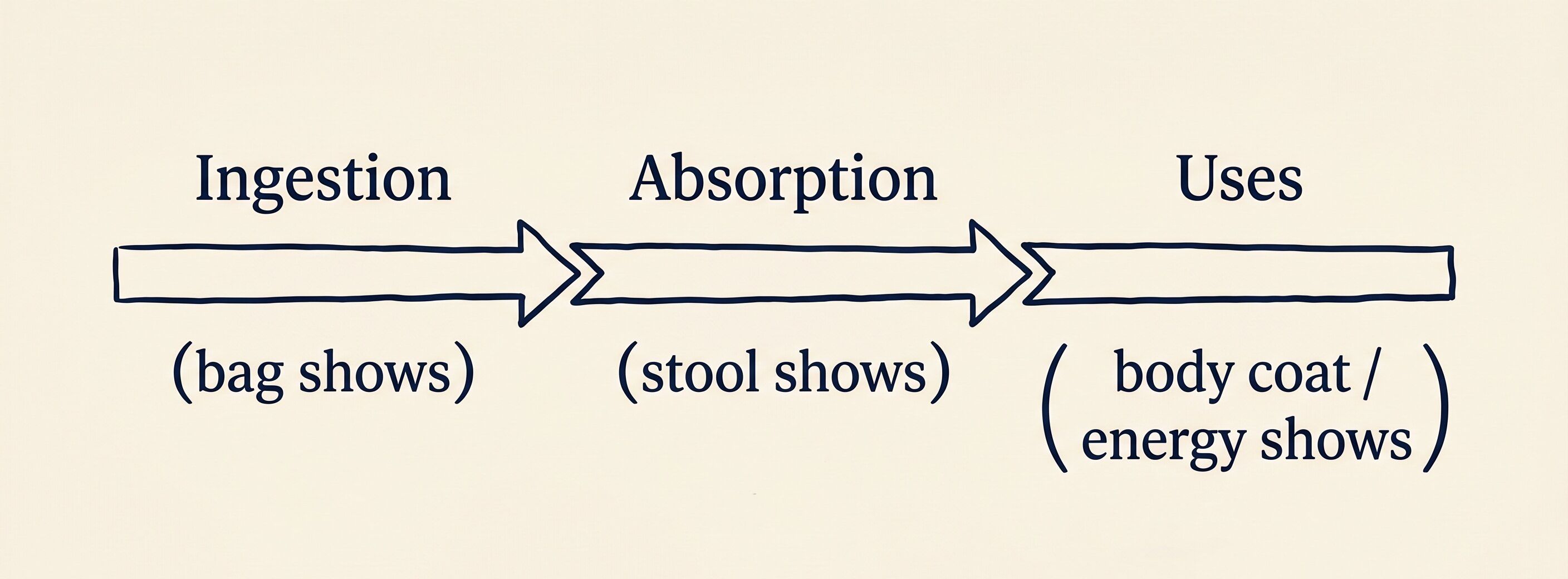
What your dog eats moves through three stages: what she takes in, what her body absorbs, and what it does with the rest. The clearest sign you can read at home is what she leaves in the bag at the end of the walk. A dog absorbing well, leaves small, formed, segmented stools. A dog absorbing poorly leaves larger, looser, more variable ones. The bag reports the first stage. The dog reports the next two.
What does my dog’s stool tell me about her food?
Your dog's stool tells you two things at once: how well the food was absorbed, and how much passed through unused. Larger, looser, more variable means more passed through. Vets score stool on a 1–7 scale — the Bristol scale in humans; the Purina Faecal Scoring chart in dogs. A steady rhythm — usually one or two well-formed stools a day for most small adults — means her body is absorbing steadily.
What does ideal stool quality look like in a small dog?
Firm enough to hold its shape. Picks up cleanly. In the brown range — paler when her diet shifts; darker can mean iron, or blood from higher up, and that’s vet territory. No streaks of mucus or fresh blood. “Ideal” is something to compare against, not a daily target — most healthy dogs vary across the week. Judge one poo and you’ll over-react. Watch across a few days and you’ll see what’s actually moving.
How long does it take to see a food change show up in the stool?
Two to three weeks in the gut. Longer for the third stage to show. Her gut bacteria adapt over weeks, not days; coat and condition take months. Don’t decide on a food at three days. And don’t decide at three weeks either, if the third-stage signs haven’t come in yet. The three-month window holds because that’s when you can finally read it — short enough to act on, long enough to mean something.
What does the stool actually tell you?
A dog absorbing well, leaves small, formed, segmented stools. Less material, because more crossed the gut wall and went into the body. A dog absorbing poorly leaves larger, looser, more variable stools. More material, because more passed through without getting absorbed. The Bristol-equivalent scale isn’t a TENDS invention — it’s veterinary teaching, useful as a reference. You don’t need to memorise the numbers to use any of this.
Frequency matters too. A sudden change in how often she goes is worth noticing on its own¹.
What do different patterns usually point at?
Patterns point at something about her food — but only sometimes. Reading her this way helps you compare. It doesn’t diagnose.
Loose, soft, larger-than-usual stools that go on for more than a few days, in a dog who’s otherwise well and on steady food: often the food just isn’t agreeing with her. Could be the protein, the fat level, the fibre, the ingredient quality, or how she personally handles one of those. The stool reads the body reading the food.
Small, hard, infrequent stools: usually a low-residue food or not enough water. Her body’s taking what it can and there’s not much left, or what’s left has dried out on the way through. Sometimes that’s by design — a dense food makes smaller stools on purpose. Sometimes it’s a sign she’s not drinking enough. Loose stool with mucus or blood — or alongside tiredness, loss of appetite, vomiting, or anything else that seems to run through her whole body: that’s vet territory straight away, not a food question. Watching her shows you something’s wrong. What it means is the vet’s job.
A sudden change while the food stays the same: usually NOT about the food. Look at everything else first — a new medication, a recent vaccination, a change in treats, a stressful week at home, something she ate on a walk, a new water source. The food’s been working for a while. The thing that changed isn’t the food.
Here’s how that looks. You switch food, and over the next ten days her stool gets looser. By day fourteen it still hasn’t settled. Everything else — treats, water, walks, home — has stayed the same. So the food is the thing that changed, and her body is telling you the new one isn’t fitting. That’s the whole thing working. You didn’t need to know which ingredient or why. She flagged that the food wasn’t right, you read it, and the next move — back to the old food, try a different one, a vet visit if it carries on — follows from what you read.
The stool grades the food only when the food is what’s actually being tested.
What can’t the stool tell you?
Here’s what it can’t tell you. The stool reads absorption well. What her body does with the food, it only hints at. That part — what she actually does with what gets across — shows up in her coat, her energy, her body condition, how she behaves, over weeks and months. The photo-comparison practice catches what the stool can’t: slow change at the surface that day-to-day looking misses.
The stool also can’t tell the difference between a food-quality problem and a this-dog problem. A food that gives one dog great results can give another dog — same breed, same weight, same home — middling ones. Reading is per-dog; the chart is the bag’s, the read is yours.
And the stool reacts to plenty that isn’t food — medication, stress, parasites, infection, the water, too many treats, an upset household. If a change sticks around, you have to look past the food before deciding anything. Watching her doesn’t replace the vet. It gives you something clearer to bring to the vet when you need one.
How do you read the report card?
Six moves, in order, none of them complicated.
First, get a baseline. What does steady look like for your dog? How often, how formed, what colour, what smell. Two weeks of casually paying attention gives you a baseline you didn’t have before. You weren’t ignoring it. You just didn’t have anything to compare against.
Second, write down the food at that baseline. Brand, formula, treats, any toppers, water source, and any supplements. When something shifts later, you’ve got the comparison. Third, when something changes, keep the food the same and look at everything else first. Medication, a recent vaccination, a change in treats, something she ate on a walk, a new person in the house, a stressful week. If none of that explains it, then look at the food.
Fourth, when you do change food, lead with the dog. Offer the new food and watch how she takes it — appetite, stool, energy. Carry on or pause based on what she shows you. Then watch what comes out for two to three weeks after the change before you decide anything. The stool takes weeks to settle into a steady response, not days¹. Decide too early, and you’ll miss it.

Fifth, take a photo if it helps you remember — same light, same surface, same time of day. The same thing that works for coat and skin signals works here. You don’t have to photograph anything. It just helps to stay consistent, and a photo is an easy way to stay consistent over weeks.
Sixth, when something carries on past two to three weeks of steady food, or when other signs show up alongside it, that’s vet territory. Bring your baseline notes — the vet works better with what you’ve already seen. You’re not replacing the vet. You’re giving the vet better information to work with.
Two months in, this just runs underneath the day. You barely notice you’re doing it. The bag is the bag. The dog is the dog. The stool is the report. The reading takes seconds. The conclusions take weeks. And the trust in your own read builds up in a way no brand’s recommendation can reach.
Where TENDS sits in this question
Superfood Blend is built for the small-breed adult and its constraints, with the second stage — absorption — as a primary design goal. It’s made to read clean on the report card. This isn’t an argument for Superfood Blend specifically. It’s an argument for a way of reading that any food, TENDS included, has to answer to. If your dog reads steady, the food is doing its job, whatever name is on the bag. If she reads unsteady on one food and steady on another, she’s graded them for you.
Three stages, one dog
The recommendations will keep coming. From the vet, the breeder, the friend, the forum, the brand, the stranger at the park. Your dog will keep grading them all. The bowl reports the eating. The stool reports the absorption. It is just a report card. The coat, the energy, and the body condition report its use.
Eats it. Absorbs it. Uses it. Three stages, three readings, one dog.
Read the dog. Not the chart. The chart wants one number. The dog has been telling you whether the chart's math landed.
Sources
1. Jergens AE, Heilmann RM (2022). Canine chronic enteropathy — current state-of-the-art and emerging concepts. Frontiers in Veterinary Science, 9, 923013. https://doi.org/10.3389/fvets.2022.923013
Written by the TENDS Nutrition & Research Team
Built within the TENDS small-breed formulation and behavioural framework


Big Brand? No.
A Smaller One — On Purpose.
Stay close for bold new moves in small-breed care.
RESET