Tear stains aren’t a coat problem. They’re a systemic message.
You’ve tried the powders. The wipes. The shampoos. Maybe the filtered water on the third try. And after a couple of weeks, the staining quietly comes back.
If you’ve watched this happen, you’re not imagining it — and the answer isn’t another product. Tear stains aren’t something in the coat. They’re a readout: what her body has been taking in, what it’s processing, and what reaches the surface and stays there because of where the surface sits.
What you’re looking at sits where three things meet: what her body takes in (food and water), what it processes (the gut, and what it sends downstream), and where the surface meets the air, the skin around the eye, the shape of any fold. Here’s each of those — and the whole-body side and the local side stay separate conversations throughout. They aren’t the same one. Most products treat them as if they were.
Why are my small dog’s tear stains so bad?
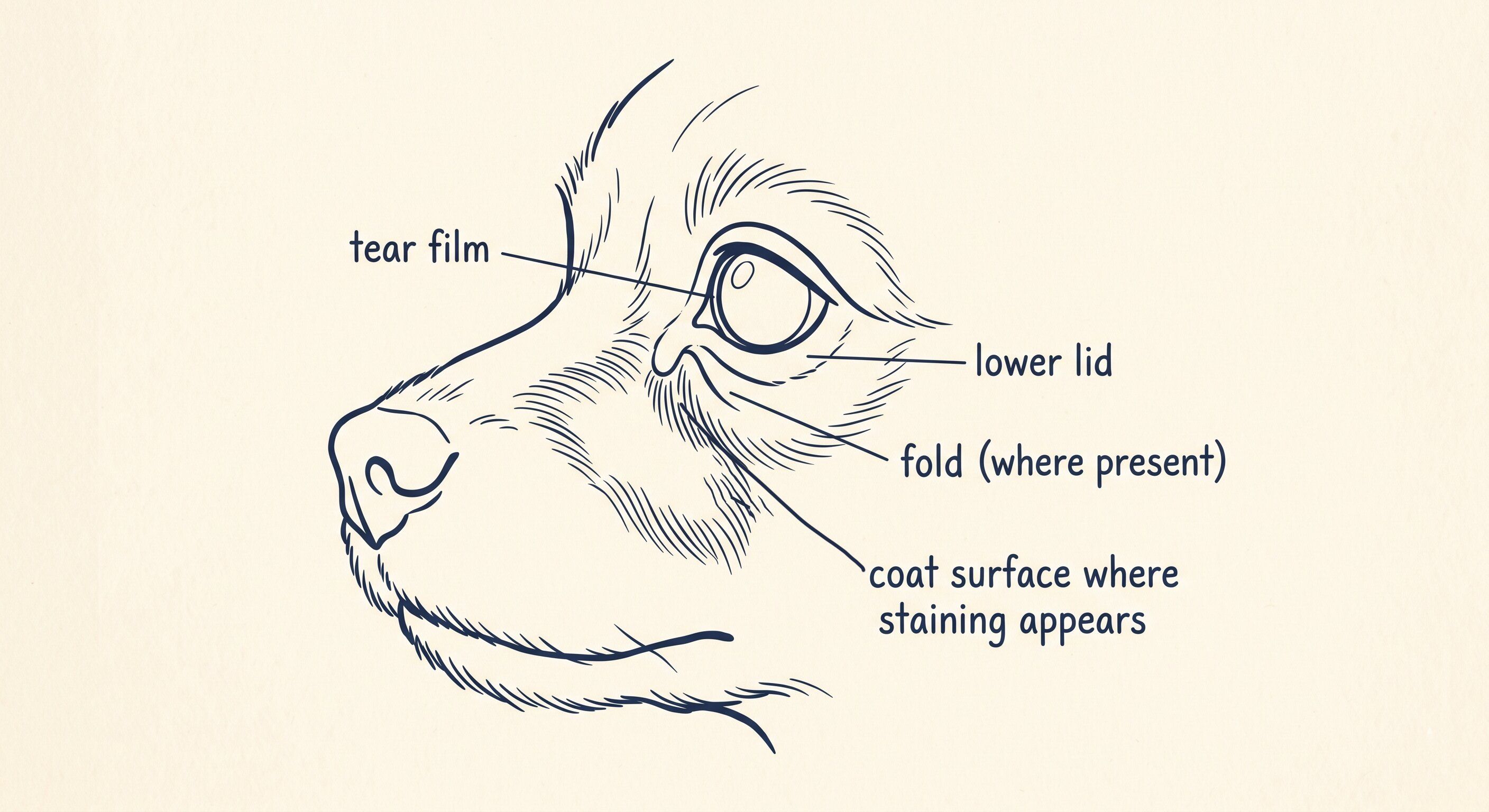
Tear staining isn’t something in the coat — it’s the surface reporting what her body has been processing. Porphyrin from tears breaking down sits on light-coated faces, reacts with light and air, and shows pink-brown. The load comes from three things running together: the minerals in her water, whether the protein suits her, and how long moisture sits before it drains. Cleaning the coat resets the count without changing what’s feeding it.
Does filtered water actually help with tear stains?
Often, yes — and it’s the cleanest first thing to try. Tap water carries dissolved minerals and traces iron, the body gets rid of through tears alongside other routes. Filter the load and less of it reaches the surface around her eyes. It doesn’t fix every case. It frequently helps the ones it fits, and it’s a six-week trial you can undo — the easiest reset, the clearest read.
Can food cause tear stains in small dogs?
In some dogs, yes — indirectly. The canine research backs the gut-skin axis¹: when the gut barrier shifts, the skin can shift in response, and what surfaces is what the body has been carrying through. The full process isn’t always straight. Some dogs run it end-to-end; others don’t. Whether the protein suits her is worth looking at after the water trial — but on a four-to-six-week timeline, not days.
Are tear stains harmful, or just cosmetic?
Mostly cosmetic at the surface — but worth reading underneath. Sudden onset, one eye unlike the other, or eye irritation point at structural causes (dry eye, distichiasis, foreign body) that diet and water can’t reach; that’s a vet visit. Gradual, even-on-both-sides staining in an otherwise well dog is read-the-input territory. The pink-brown is information, not damage — a readout of what the surface holds, not harm in itself.
Why does the staining come back where it does?
Skin doesn’t behave the same everywhere. The biology that runs the paws is different from the biology that runs the folds, and the biology around the eye is different again. The skin around the eye is thin. Tear film moves across it constantly. Moisture doesn’t drain on its own — it sits, especially where there’s a fold. In flat-faced breeds it sits more, because the shape of the face holds more.
What the surface holds is what shows. The pink-brown that builds up around white coats is porphyrin — an iron-containing pigment the body makes from the breakdown of haemoglobin and gets rid of through tears, saliva, and urine. When porphyrin sits on a coat in light and air, it reacts. The colour deepens. On a darker coat, you’d never see it. On a Maltese, a Bichon, a Coton, a Westie, a poodle bred light, you can.
That detail matters, because it changes what the “stain” actually is. It isn’t pigment in the fur. It’s the visible record of what the surface has been holding — minerals from saliva that wicks into the muzzle ruff, porphyrin from tears that pool around the eye, the residue that builds up because the moisture didn’t leave on its own. Cleaning the coat doesn’t change what’s feeding it. It just resets the count.
What is the gut sending to the skin?
That’s only half of it. The other half is what arrives.
In some dogs, what’s happening upstream — at the gut — shows up at the skin. The canine research is getting clearer on this: in dogs, the gut and the skin are connected through what’s called the gut-skin axis¹. In plain language, it runs through three things at once. First, a leaky gut barrier — when the lining of the gut isn't holding its tight junctions cleanly, more material than usual passes through the bloodstream². Second, the gut microbiome — the resident community of bacteria whose state moves with how the immune system reads what arrives³. Third, the skin's own ecology, which can shift in response: an imbalance on the skin, often with Staphylococcus taking over, is what surfaces¹.
The full process isn’t always clean. The research backs each link, but doesn’t yet close the loop in a single long-term study. Which means: in some dogs the process runs end-to-end. In others, only part of it does. The link is real. It just isn’t always straight in any one dog.
A parent in a Maltese community described a ten-month run with this shape: tried protein after protein for the staining, none of them held; a vet dermatologist patch-tested and found the dog was allergic to nearly every common protein.
On an insect-protein diet, the staining she’d been managing topically for almost a year cleared in a month. That isn’t every case. But it’s the shape parents land on over and over — whether the protein suits her, gut response, skin response, in that order, on a timeline of weeks to months.
The coat is, often enough to be worth listening for, food reaching the surface. In some dogs, the skin reports what the gut couldn’t finish.
What does the water actually carry?
The other input the surface reads is water. The one thing parents in white-coated-breed communities reach for most — more often than any food change — is a water filter. There’s a reason underneath it. Tap water carries dissolved minerals and traces iron, the body deals with alongside everything else. What her body uses moves through. What it doesn’t can surface where the body gets rid of it — and tears are one of the routes. Filter the water and less of that load reaches the surface around her eyes. It doesn’t fix every case. It frequently helps the ones it fits.
There’s no clean number here that maps neatly onto a dog. The load varies by region, by pipe age, by treatment plant. What matters is that the load varies, is often invisible, and that filtering takes out a meaningful share of it without you having to work out which mineral it is. It’s cheap, you can undo it, and it’s a six-week trial. It belongs first in the order for a reason.
How much she drinks isn’t the variable here. The system is the same in every dog: water comes in, gets sent around, gets used, leaves through breath, urine, and the surface. What changes is what’s being carried along with it.
In flat-faced breeds, the margin is tighter still — not because the system is different but because the shape around the eye holds more, and what gets held has more time to sit against the surface. The water doesn’t behave differently. The holding does.
How do you read this in your own dog?
Before any of this becomes a food question or a water question, it’s worth asking whether the staining started suddenly, whether one eye is different from the other, or whether the eye itself looks irritated. Those point at structural causes — distichiasis (eyelashes growing the wrong way and rubbing against the eye), keratoconjunctivitis sicca (dry eye), primary glaucoma, a foreign body in the conjunctiva — that diet and water can’t reach. That’s a vet visit, and it’s the right place for it.
If the staining is gradual, on both sides evenly, and she’s otherwise well, then it becomes a question of variables. Change one at a time. Try the water first — it’s the easiest reset and it gives back the clearest read. Hold the change for at least six weeks before you decide. Then, if the staining sticks around, look at the food and whether something in it might be involved. The skin trails the gut by weeks, not days; real change usually takes four to six weeks to show. Change two things at once and you won’t know which one moved the needle.

And one quiet practice that catches what daily looking can’t: a photograph of your dog’s face, same lighting, same angle, same time of day, once a month. The eye doesn’t register slow change. The camera does. After three months you can lay them side by side and see what your daily attention couldn’t — what cleared, what didn’t, what’s quietly returning.
Where does TENDS sit in this question?
Two of the things TENDS makes sit alongside this question, on the two sides of line that’s been running through all of this.
The Hydration Ritual SHINE blend supports skin and coat from within. It’s the whole-body side — what’s getting delivered, not what’s sitting at the surface. This blend supports both — from within.
The TENDS Touch Eye balm supports the skin around the eye where moisture and friction repeat. It is, on purpose, not a tear-stain product. The staining is what you see; the Eye balm cares for what’s underneath it — the surface where moisture stays, where contact happens daily, where light, frequent, gentle care belongs.
Together they hold the same line. Different layers, same day.
What three months of photographs catch
What three months of photographs catch is what daily looking can’t: slow change.
Looking back isn’t how good she looks now. It’s how much she’d been carrying that you’d stopped seeing. The wipes have their place. So do the shampoos, the food, the water, the vet visit if something shifts suddenly. But the habit underneath all of them is the one nobody sells.
Read the dog. Not the chart.
Sources
1. Thomsen M, Künstner A, Wohlers I, et al. (2023). A comprehensive analysis of gut and skin microbiota in canine atopic dermatitis in Shiba Inu dogs. Microbiome, 11, 232. https://doi.org/10.1186/s40168-023-01671-2 2. Jergens AE, Heilmann RM (2022). Canine chronic enteropathy — current state-of-the-art and emerging concepts. Frontiers in Veterinary Science, 9, 923013. https://doi.org/10.3389/fvets.2022.923013 3. Rostaher A, Mueller RS, Majzoub-Altweck M, et al. (2022). Comparison of the gut microbiome between atopic and healthy dogs — preliminary data. Animals, 12(18), 2377. https://doi.org/10.3390/ani12182377
Written by the TENDS Nutrition & Research Team
Built within the TENDS small-breed formulation and behavioural framework


Big Brand? No.
A Smaller One — On Purpose.
Stay close for bold new moves in small-breed care.
RESET