The trap that doesn’t feel like a trap — toppers, treats, and what your dog is actually learning
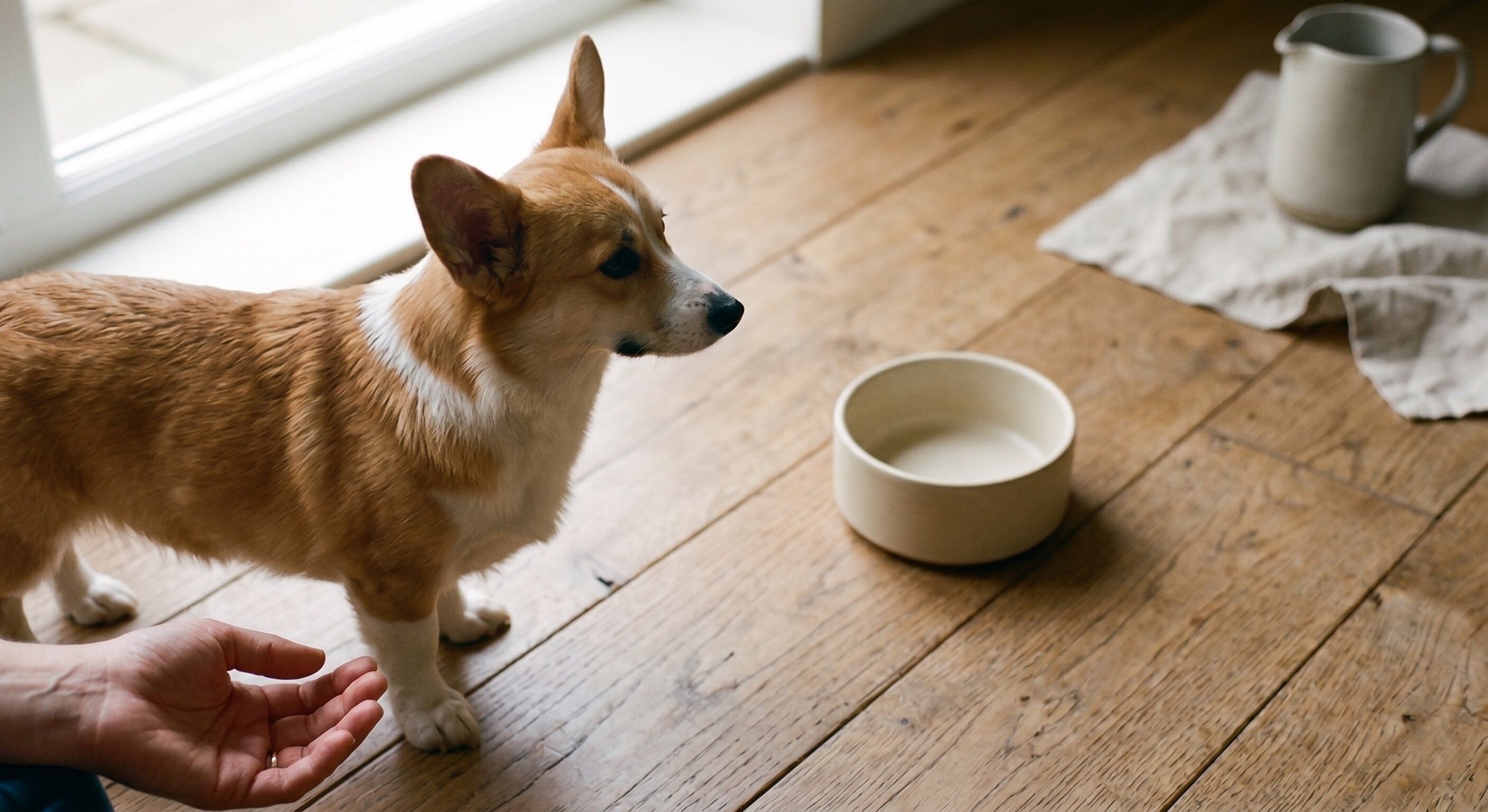
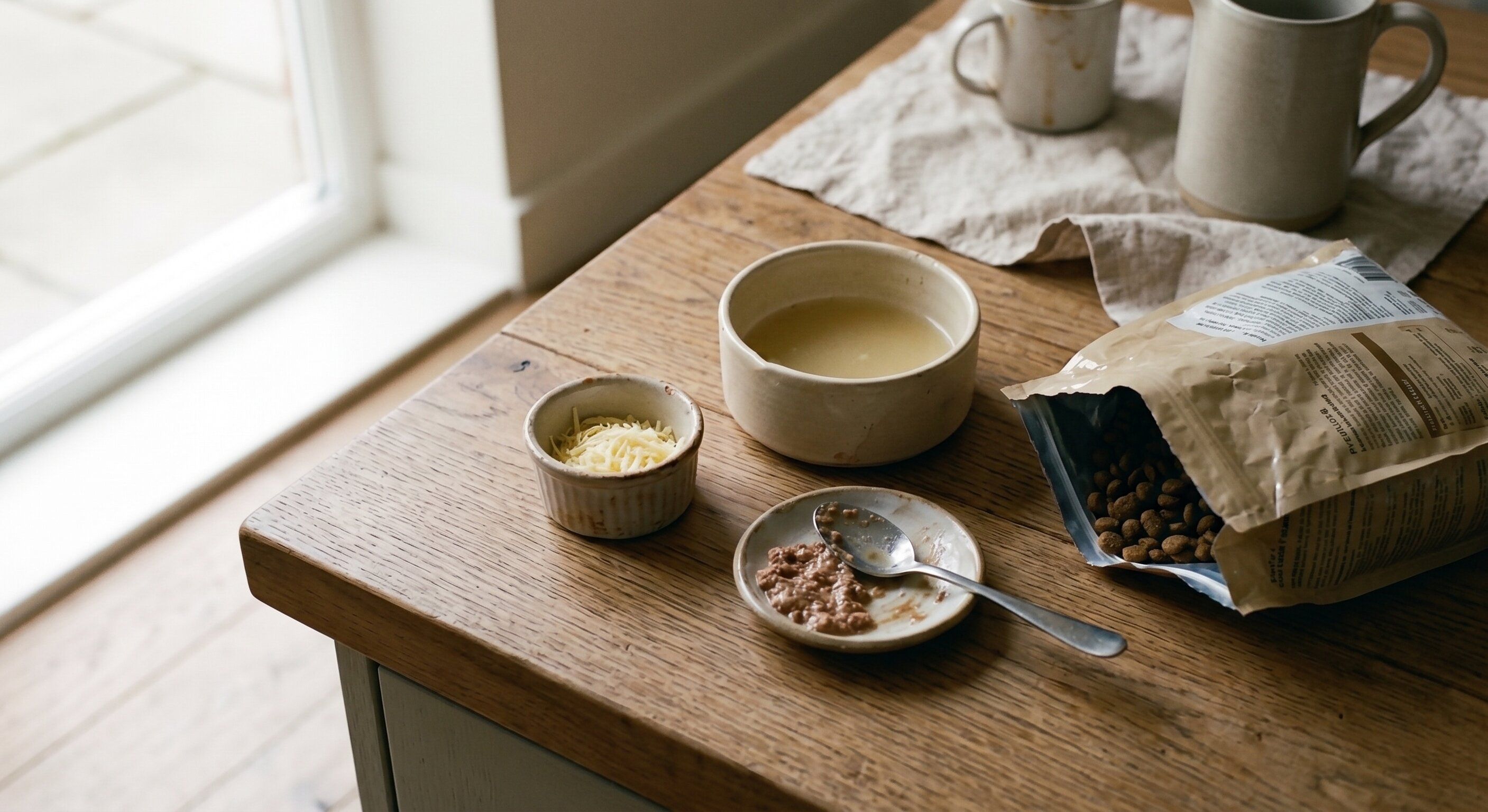
Parents in small-breed forums have been describing the same scene for years: dog walks away from the bowl. You reach for the cheese, the broth, the spoon of wet. She comes back. The bowl gets eaten. You count it as a win.
Two weeks later, she won’t eat without the cheese, the broth, or the spoon of wet.
You read it as: she’s gotten picky.
She learned exactly what the bowl was teaching.
Why won’t my dog eat plain kibble anymore?
She learned what the bowl was teaching. Every refusal is a training session you didn’t know you were running — she refuses, you pause, you reach, something better arrives. She reads the pattern correctly and tries it again on the next bowl. By bowl ten or twelve, she’s sure of it. She isn’t being stubborn. She’s reading a pattern that keeps coming true and acting on it.
How did my dog get picky?
Two things running together. First, her senses get used to it — the topper that worked Monday is just background by Friday. And second, she’s learned that refusing gets rewarded with something better, so she keeps refusing. Each round raises the bar a little higher than the last. From where you’re standing, you only see the latest move. From the outside, the whole drift shows. A friend who hasn’t seen her in three months is often the one who catches it.
Did I cause my dog’s picky eating?
Not in a way you should feel guilty about — this loop isn’t a failing on your part. It doesn’t need anyone to mean for it to happen; it just needs to keep happening the same way. The worry behind the topper escalation makes complete sense: your small dog seemed not to be eating, and you wanted her to eat. It’s that response to the worry that’s worth looking at again. The thing that changed in the loop isn’t her appetite. It’s the hand reaching for the cheese.
How do I get my dog to eat without toppers again?
Do the schedule reset once you’ve ruled out anything physical. One base food, three meals at fixed times, twenty minutes per bowl, no toppers. Three weeks at least. Most dogs come around inside that window. The fix isn’t softer food or better food — it’s changing what gets rewarded so she re-reads the pattern. The schedule isn’t punishment. It’s the new pattern you and she get to learn together.
What was actually getting taught
She walks away. Something better arrives. She comes back. The next bowl goes down the same way, and now she’s got a theory: refuse first, see what gets added. She tests the theory on the next bowl, and the next, and the bowl after that. By bowl ten or twelve, the theory is fact.
The thing that changed in this loop isn’t her appetite. It’s the hand reaching for the cheese.
This is the same kind of watching the signal-normalisation primer walks at the whole-body level — looking at what’s actually in front of you without letting the daily eye paint over it. Here you turn that same watching inward. She isn’t the thing to watch. The hand is.
What the dog actually learned
Small-breed stomachs are small. A grown dog fills up in the time it takes to eat normally, for ten to fifteen minutes. The standoff at the bowl — she refuses, you pause, you reach, something better arrives — all happens inside that window. She doesn’t have to wait until she’s full to make her move; the move gets made before full ever comes up.
That’s the mechanical part. The behaviour part sounds technical, but is actually very simple: when something gets rewarded, it gets repeated. She’s reading a pattern. The pattern holds. She acts on the pattern that holds. What’s getting rewarded isn’t pickiness. What’s getting rewarded is refusing. Refusing brings the upgrade. She’s found a strategy that works. Within ten to fifteen rounds — call it two weeks at three meals a day — the strategy is locked in.
The dog isn’t being clever about it. The dog isn’t manipulating anyone. The dog is doing what every dog would do given the same sequence of inputs. The behaviour the owner names “picky” is the dog reading the household correctly.
The hand reaching for the cheese was the variable. The dog was the constant.
Why it feels like the dog is the problem
From inside the loop, what you see is: my dog is fussy. My dog has preferences. My dog won’t eat normal food. My dog is one of those dogs.
What you don’t see is the loop you’re inside, because the loop is your hand.
The same thing happens here, just at a smaller scale. When you see something every day, it starts to look normal. You stopped noticing the moment she refuses — it's just what mealtime looks like now. And you stopped noticing the moment you add something extra to the bowl, because that's just how the bowl gets made. Both things faded into the background. What you're left seeing is the dog, refusing.
The dog became the data point because the hand stopped being one. None of this asks you to feel bad. It asks you to put your hand back in view. The loop wasn’t a failure; it was a training session that got easier than feeding the dog. Most households arrive here through the same door — through care, through giving in, through wanting the dog to eat. The mechanism doesn’t care about why. It just runs.
Why this is a wellness reframe, not a training problem
This isn’t about training. The frame matters.
A training problem says: the dog needs to behave differently. A training answer asks the dog to change.
A wellness reframe says: the loop needs different inputs. Her behaviour is a clean read on the inputs she’s got right now; change the inputs and the read changes with them. She isn’t the problem to solve. The loop is.
This is the same watching parents bring to the household, the bowl, the dog. The mechanisms are biological — how full she gets, how quickly, what gets rewarded. The fix is about behaviour, and it lands on the household, not on the dog. She reads the new pattern as cleanly as she read the old one.
This is what parents have found for themselves, not a TENDS invention. It comes from people who watched the loop run on them and named it.
What changes when the hand stops being a variable
The nuts and bolts — the schedule itself, the timing window, what to do meal by meal — are walked through at the schedule the community keeps coming back to, so there’s no need to go through them again here. What you get here is the why underneath the schedule.
Refusal is information, not a request. Her walking away is data about the pattern right now. It isn’t a question waiting for an answer; it’s a sentence. The sentence is more useful left unanswered than answered.
The hand stays out of the bowl. What the bowl has today is what the bowl had yesterday. The bowl gets to be the bowl. The hand gets to not be a variable. The third week is the read. The pattern she learned over two weeks doesn’t unlearn in two days. The new pattern needs about the same stretch of time to register. By the end of the third week, the loop has either broken or it hasn’t. If it hasn’t, the step before this routes back to the diagnostic check — something physical the first scan missed, something the reset wasn’t built to fix.
The work is at the household level. She’ll read whatever pattern the household holds. The pattern that holds wins.
Where TENDS sits in this question
A food worth standing behind makes the un-training easier, because there’s no upgrade waiting. The bowl is the bowl whether she refuses it or eats it; nothing that arrives later changes what it is. Superfood Blend is a base food the schedule reset asks for — same density, same substance, every meal. The product fits the principle; the principle isn’t the product.
What the loop was, and what it can be
She learned a pattern in two weeks. The pattern was clean, and she was right to learn it.
A new pattern, held at the household level, takes about the same stretch of time to land. Read the dog. Not the chart. She’s reading you the whole time. The reframe is what you let her read.
The hand is part of the system.
Written by the TENDS Nutrition & Research Team
Built within the TENDS small-breed formulation and behavioural framework


Big Brand? No.
A Smaller One — On Purpose.
Stay close for bold new moves in small-breed care.
RESET