When picky is physical — the diagnostic step before the topper escalation
You started with a spoon of bone broth. Now there’s a small system: a spoon of wet, a sprinkle of cheese, a few seconds of warming, the bowl held at the right angle. And still, on a Tuesday, she walks away from it.
If you’ve watched the ladder of toppers get longer, you’re not imagining it — and the answer isn’t another topper. Picky eating is, often, the dog telling you something physical that the topper escalation is hiding.
What the escalation does, mechanically, is mask. Each new topper covers what the dog has been refusing — the food, but also, sometimes, the reason for the refusal. Here’s the question that goes underneath: before the next topper, what might be there to read? This isn’t a criticism of giving in. The fear behind it makes sense. It’s the response to the fear that’s worth slowing down.
Why is my small dog so picky?
Sometimes — often enough to matter — picky eating is the dog reading the food as something her body has trouble with. Years of parents watching turn up three patterns: an undiagnosed protein allergy, low-grade pancreatitis, reflux teaching the dog away from what hurt. Going up the topper ladder hides the physical read. Before the next topper goes on the bowl, the question worth asking is whether the refusal is biology, not behaviour.
How do I tell if my dog’s picky eating is physical?
Three things point at biology: it came on suddenly rather than drifting in slowly; tiredness or gut trouble running alongside; refusal that holds across food types and brands rather than across one specific bag. What you’d grade as mild or bad doesn’t always track what her body is actually carrying — flat-faced dogs in particular can be quietly handling more than the household sees. When the timing or the pattern shifts, the vet step comes first.
Why does my dog only eat with toppers?
Two things run together. Her senses adjust — the topper that worked Monday is just background by Friday. And she learns the pattern: refuse, pause, and the upgrade shows up. Neither one is on purpose. Each round sets the bar for what counts as good enough a little higher than the last. The dog isn’t training the household; both sides are reading patterns that hold up and acting on them.
Will my dog starve if I take the toppers away?
Healthy adult dogs handle short gaps between meals without harm — going a while without food is normal dog biology. The reset works because the dog reads the new pattern: bowl down, twenty minutes, bowl up. Most dogs come around inside three weeks once the vet step has cleared physical causes. The fear behind the topper escalation makes sense; it’s the response to the fear that the schedule reset slows down.
What is the topper escalation actually doing?
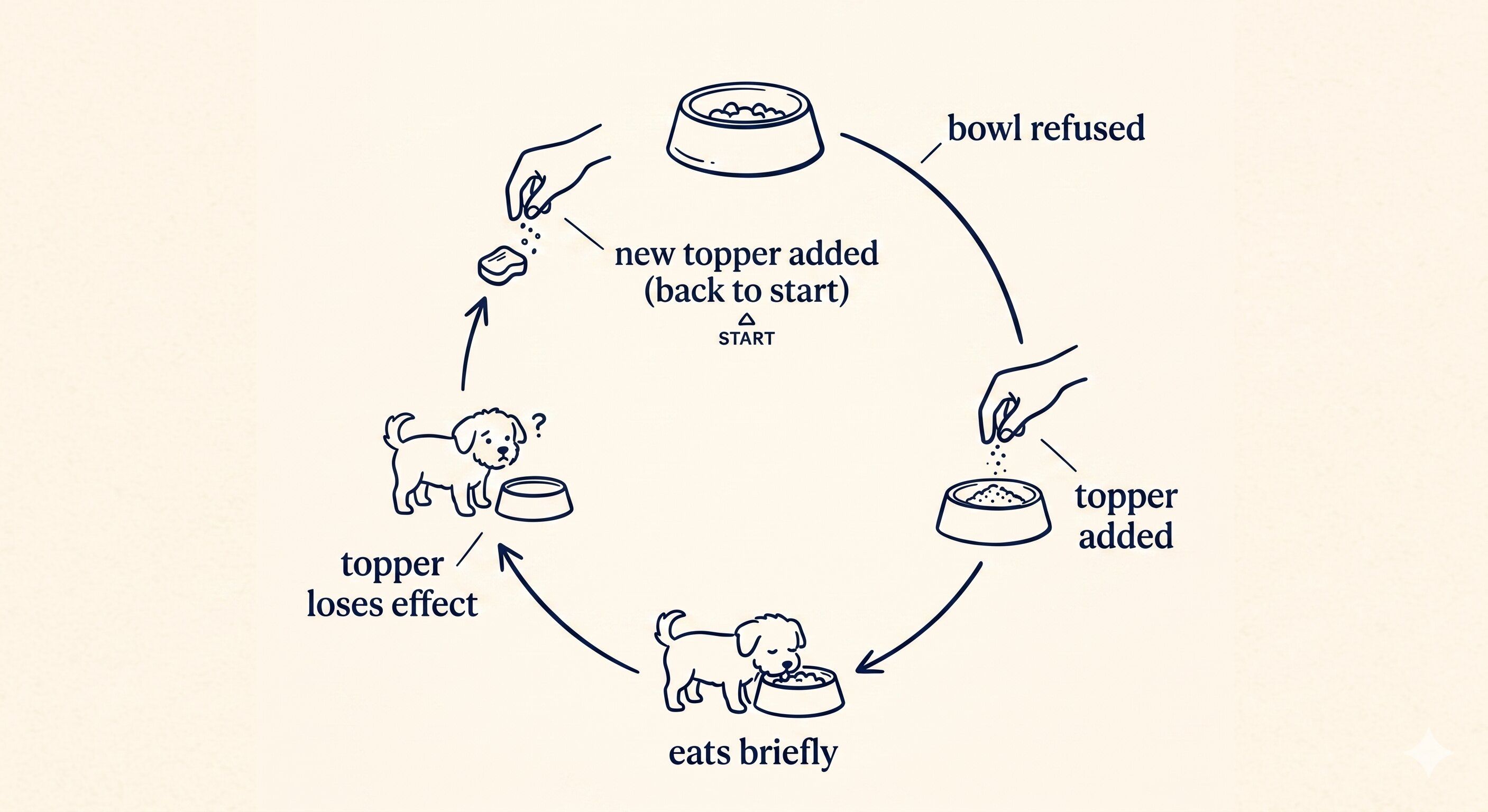
The first topper works because it’s new. Something new makes the food appealing enough to clear the bar the bowl had been sitting under. The dog eats; you relax. Then the new wears off — dogs get used to things fast, and the topper that worked on Monday is background by Friday. The bowl gets refused again. A new topper comes in. The bar moves up. Each round sets the bar higher than the one before.
This isn’t breed personality. It isn’t stubbornness. It isn’t the dog deliberately holding out for better. It’s two things running together — the dog getting used to things, and a loop in the household where refuse-then-give-in feeds the very thing both sides are now doing. The dog isn’t training you; the dog is reading the pattern accurately, the same way she reads when you reach for the leash. The learning doesn’t need intention from either side. It just needs consistency.
What hides the loop from inside is timing. The dog gets used to a topper in days. The household notices the new bar in weeks — by the time you’ve clocked that the cheese isn’t working any more, the next thing has already come in. From inside the cycle, all you can see is the latest move; the whole arc is invisible. A friend who hasn’t seen the dog in three months is often the one who notices.
Calling it breed personality is what makes the loop hard to see. Is this a poodle thing? Frenchies just inhale. Shih Tzus have such sensitive stomachs. Cavaliers are picky royalty. Each label tells you what kind of dog you have, which is true. Each label also tells you the refusal is normal for the breed and so not worth looking into. That’s the part that closes the door before the vet step has happened.
What you do is part of what they are. Not in a guilty way. In a literal one — the routine you’ve built around the bowl is now part of the system the bowl sits inside.
What might the refusal actually be?
Underneath the loop, often enough to matter, is something the dog has been telling you in the only language she has: refusing the food.
Three patterns turn up over and over. A Shih Tzu owner whose dog had been called picky for months found out the dog was allergic to chicken; once chicken came out, she ate normally. A Poodle owner who finally asked an internal medicine specialist heard the explanation: dogs sometimes become picky when the food makes them feel bad, because they link the food with feeling bad. Pancreatitis, in that case. A third dog’s refusal was reflux — the food was being paired with the discomfort that followed it, until she turned against it. The dog stopped wanting what hurt.
Each case is different in cause; each is identical in shape. The dog refused. The owner read the refusal as behaviour. The behaviour was actually a body reading the food, and the body was right. The reason this is hard to see is that how bad you think it is doesn’t track what her body is actually carrying. In flat-faced dogs specifically — Frenchies, Pugs, Shih Tzus — how bad owners rate the reflux has been shown not to predict the real burden the dog is bearing¹. The dog can be quietly handling more than the household sees.
This doesn’t mean every refusal is physical. Some refusal is genuine preference. Some is built up by giving in, in the loop named earlier. The reframe is narrower than that: before the next topper goes on the bowl, the question is whether the refusal might be the body, not the behaviour.
When it’s not behaviour, it’s biology.
What does this look like in your dog?
What to read for — for whether something physical might be there:
Stool that’s loose, soft, or different in shape. Vomiting, especially yellow bile in the early morning. Gas, lip-licking, repeated swallowing. Slow chewing, or coming to the bowl and stopping mid-meal. Itching, ear infections, paw-licking that wasn’t there before — sometimes a food signal surfaces on the skin before it shows up in the bowl.
And the questions worth asking before any of this becomes a vet question: Has anything changed in the last four weeks? A new food, a new person in the house, a vaccination, an illness, a course of medication, a switch of treats. Has the way she refuses changed — sniff-and-walk-away versus eating-and-stopping versus crying-while-eating? Is anything else going on alongside it, even quietly, even things you’d been calling normal?
This is watching her, not running a protocol. You’re looking at the dog. The bowl is one of the things the dog is showing you.
How do you check before adding the next topper?
Three moves, in order.
First — if anything you’re reading points at physical, the next step isn’t another topper. It’s a vet visit. The diagnostic process — the questions a vet asks, the panel they run, a supervised food trial if it comes to that — belongs in their hands. The diagnosis isn’t something to do from here.
Second — if nothing points at physical and the refusal came on slowly, the schedule reset is what parents keep coming back to. One base food, three weeks, no toppers. Three meals at fixed times. Bowl down for twenty minutes; up after, eaten or not. Repeat. The schedule works because it takes away the new-thing cycle the loop runs on — when nothing new ever shows up, her senses have nothing to chase. The dog reads the bowl again as the steady thing in the day.
What “no toppers” means in practice: no warming, no sprinkling, no broth, no wet stirred in. Water yes. Treats cut back to a small handful per day, used for training only, kept off the bowl. Three meals because for a small dog, two stretches the gap; one is the schedule the cycle started inside; three is enough to feel like routine without becoming a negotiation. Success in the first week looks like a couple of skipped meals and a calmer bowl by Friday. Most dogs come around inside three weeks. Some take longer. A few don’t, and the third move below is for those.

Twenty minutes feels long. The fear under the feeling makes sense — going without food matters in a small body. It also matters less inside a single day than across several; in a healthy adult dog, one missed meal is generally fine². The schedule isn’t asking for hunger. It’s asking for no negotiation.
Third — if the reset doesn’t break the cycle in three weeks, the question goes back to the vet step. Something physical may be there that the first scan missed.
Where TENDS sits in this question
Superfood Blend is the kind of base food the schedule reset asks for — designed, density-matched, consistent enough across seasons that the dog can read it without surprises. Where the vet step shows nothing physical and the cycle is a learned habit rather than biology, this is the food that makes the reset possible. Where the vet step finds something the food alone can’t reach, the vet’s prescription pathway is where to be.
What goes before the next topper
The next topper isn’t always wrong. Sometimes the dog has earned a different bite, or the routine genuinely needs lifting. But the question that goes before it is the one the topper aisle skips. Was it behaviour, or was it biology? Has anything quietly changed? Is there something else, beneath the refusal, the bowl is being asked to carry?
Read the dog. Not the chart. The diagnostic step is what the reading actually is.
Sources
1. Appelgrein C, Hosgood G, Thompson M, Coiacetto F (2022). Quantification of gastroesophageal regurgitation in brachycephalic dogs. Journal of Veterinary Internal Medicine, 36(3), 927–934. https://doi.org/10.1111/jvim.16400 2. Leung YB, Cave NJ, Heiser A, et al. (2020). Metabolic and immunological effects of intermittent fasting on a ketogenic diet containing medium-chain triglycerides in healthy dogs. Frontiers in Veterinary Science, 6, 480. https://doi.org/10.3389/fvets.2019.00480
Written by the TENDS Nutrition & Research Team
Built within the TENDS small-breed formulation and behavioural framework


Big Brand? No.
A Smaller One — On Purpose.
Stay close for bold new moves in small-breed care.
RESET