Coat as systemic signal — beyond fish oil and shampoo
You’ve been watching her coat. The dull patches at the rump. The thinning around the muzzle. The fur that didn’t come back the way it usually does after the spring blow. You reach for fish oil because that’s what the category tells you to — and most people you ask will say the same.
Her coat is the slowest part of her to change, so it’s the last to show you anything. What’s growing through right now is showing you what her body was doing weeks to months ago — and what her body managed to deliver, absorb, and finally use to reach the follicle. For some dogs the supplement works. Forsome it doesn’t. Here’s what decides which.
Here’s both halves out loud. There’s real science under the coat-as-sign idea, and most of it has been measured at the skin and barrier level rather than at the coat itself. The math is honest. Fish oil is the category’s standard way of getting omega-3 into her; it works for some dogs because of one thing, and doesn’t for others because of another. Here are the layers, without throwing out the habit.
Why does my dog’s coat look dull, brittle, or patchy?
Her coat shows what her body has been delivering, absorbing, and using over the last eight to twelve weeks. Dullness, brittleness, patchy thinning are surface signs of something further up. Often it’s the food. Sometimes it’s the world around her (sun, friction, how often she’s bathed). Sometimes it’s hormonal or seasonal. Sometimes it’s her gut and her skin telling you the skin barrier has been carrying load. The coat shows you where things are heading; what’s behind it is a separate read.
Will fish oil fix my dog’s coat?
Sometimes — when the thing that was off was DHA. Fish oil is the category’s standard way of delivering DHA, the long-chain omega-3 that skin and coat actually use. That’s why people reach for it, and that’s why some dogs get better. The deeper question is whether the DHA is being absorbed and reaching the follicle. Some dogs run that chain cleanly. Others don’t. The conversation goes past the bottle.
How long does a food change take to show in the coat?
Weeks, not days — and usually months, not weeks. The keratin growing through right now started forming eight to twelve weeks ago. Real coat change usually takes two to three months to show. The skin lags the gut by weeks; the coat lags the skin by weeks more. Don’t decide on a food at three days. Don’t decide at three weeks either, if other signs haven’t started moving.
Is dull coat always a food problem?
Not always. Coat reacts to plenty: season, age, hormonal cycle, sun, friction, how often she’s bathed, the humidity around her. Food is one part of that, often an important one. The trick is to watch where things are heading before you decide the cause. Watch a few things over weeks — coat alongside stool, alongside skin, alongside energy — and you’ll see what’s actually going on. The coat opens the question. The rest of the read closes it.
What the coat is actually reading
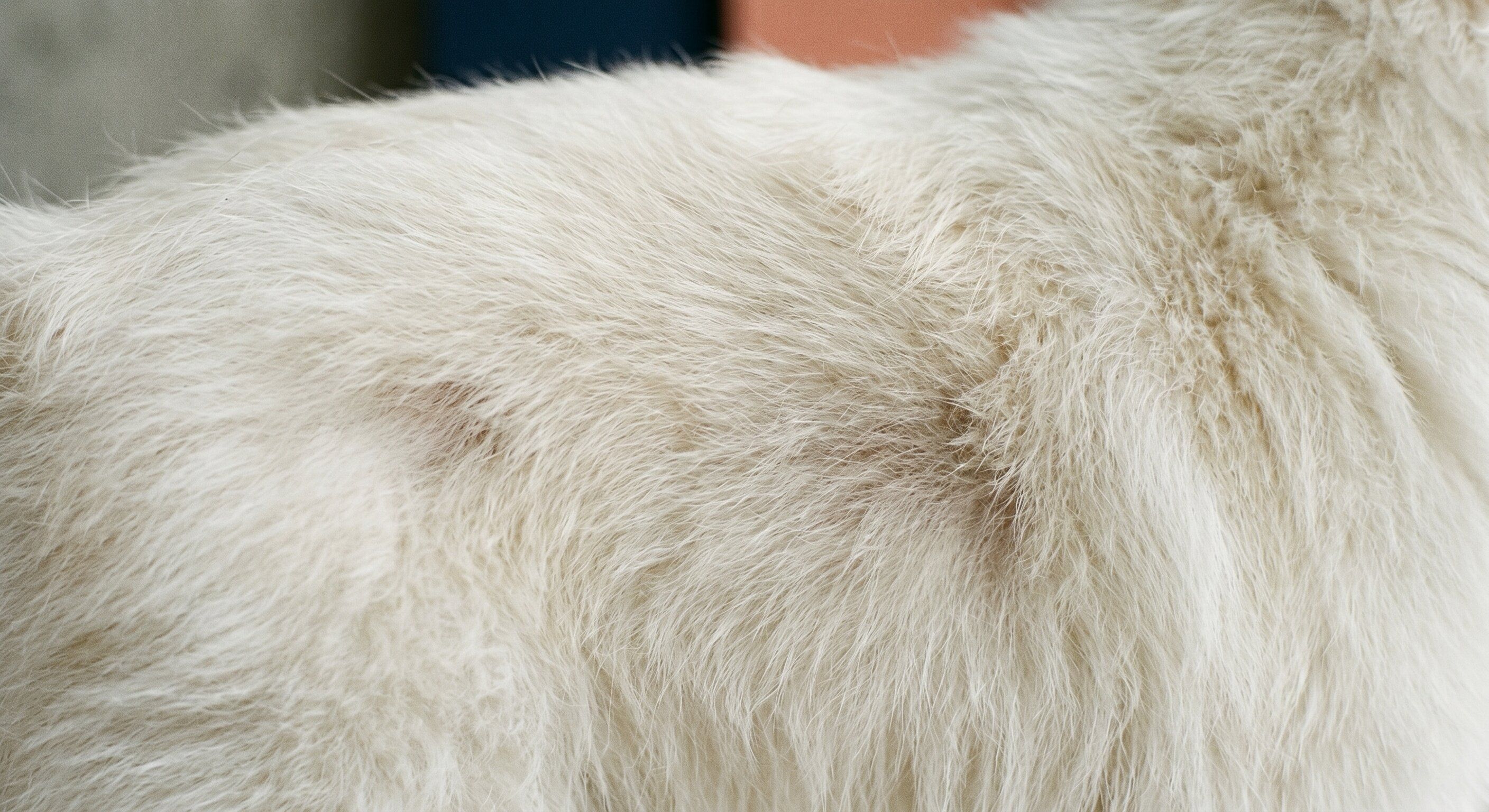
The coat is the third stage of nutrition made visible. The first stage is what arrives in the bowl. The second stage is what crosses the gut wall and gets into her blood. The third stage is what reaches the follicle, the skin, the muscle. What her body actually managed to do with what got across.
Coat is the third-stage read that takes the longest to show, because keratin grows slowly. The hair growing through her coat right now started forming somewhere between eight and twelve weeks ago. What the follicle was getting back then is what your eye is reading now. The eye is calibrated to yesterday; the coat is calibrated to last quarter.
That makes coat a different kind of sign from skin. Skin reads what’s right there — moisture, the barrier holding, the balance of bugs on the surface, contact with the world. Coat reads what reached the follicle after delivery, absorption, and her body putting it to use. The two run together — most dogs whose coat shifts are also showing you something at the skin — but they aren’t the same read.
The coat is the body's slowest signal. That's why daily attention misses it.
Where omega-3 supplementation actually works
What sits underneath the fish-oil habit is omega-3 — and specifically DHA, the long-chain version skin and coat actually use. Shorter-chain plant omega-3 like ALA from flaxseed converts poorly in dogs; DHA is what reaches the follicle. Fish oil is one way to deliver DHA, the one the category has settled on. It’s why so many parents reach for the bottle. DHA is what fish carry — and microalgae is where the fish got it.
What the habit doesn’t carry is the absorbing part. Three kinds of dog explain what you actually see when you try the bottle. The dog whose coat gets better on the supplement. Her diet was short on DHA; the bottle gave her enough; her body was absorbing it; DHA reached the follicle. This is the group parents talk about most loudly, because you can see the result.
The dog whose coat doesn’t get better on the supplement. DHA was getting in. The hold-up was absorbing it or the barrier — what crossed the gut wasn’t reaching the tissue, or what reached the tissue wasn’t being used because inflammation running through her whole body was the real problem. The bottle delivered; her body couldn’t follow through. The dog whose coat gets better and then stalls. Delivery fixed the shortfall; what’s left is absorbing work the supplement can’t do on its own.
The habit isn’t wrong. It’s just incomplete. The bottle is the way in. What actually causes the change is whether her body can carry the stuff all the way through to the surface.
DHA delivery is an entry point. Absorption is the cause.
What sits underneath
The mechanism linking what goes in to what shows up on the surface is general dog biology — not small-breed-only — applied to small dogs. How well the gut wall holds and how well the skin barrier holds can each be measured on their own; both are off in the same dogs more often than the research can yet explain¹. Skin trouble with Staphylococcus taking over shows up alongside chronic gut disease in groups of dogs studied at the small-to-medium size². What this means for the coat: the coat reads the skin, and the skin reads the gut. Or more exactly, the coat reads what the skin couldn’t repair, and the skin reads what the gut couldn’t finish processing. In some dogs the chain runs cleanly. In others one of the layers is the hold-up — and that’s where the supplement reaches her body but not the follicle.
One honest qualification the research asks for: most dog-skin studies measure itch, visible skin damage, and the skin barrier — not the coat itself. The coat improves as the skin and barrier improve; the connection is real but not perfectly direct. TENDS says both things openly rather than claiming more than the research shows.
Skin doesn’t behave the same everywhere. Coat doesn’t either.

How to read your dog’s coat
Five things to hold in mind. Not a schedule. The schedule belongs to the calendar; these belong to the chain.
Read over months, not days. Take a photo from above (back and flanks) once a month, same light, same time of day. After three months, lay them side by side. The coat speaks month to month because keratin grows month to month; your eye is calibrated to yesterday and misses it. Less is what gets noticed first — the dullness today, the shift in colour, the thinning behind the ribs — but it’s the run across months that shows you what’s actually moving. The photo-comparison practice walks you through it.
Watch the spots where your breed shows it first. Different breeds tell you in different spots. Maltese and shih tzu show it through tear-staining and pigment brightening. Poodle coat shows it through curl and texture. The pug’s black coat shows it through how deep the colour is. Yorkie coat shows it through how silky it stays. After a few months of watching, you’ll learn which spots your dog shows it through
Watch where it’s heading, not the single day. Real coat change usually takes two to three months to show; the full picture lands at the three-month observation window. A sharp change between two months in a row — a sudden patch, a quick colour reversal, signs running alongside the coat (tiredness, symptoms that keep coming back, a shift in how she behaves) — is vet conversation territory.
Tell coat signs from skin signs. Coat reads what reached the follicle after her body finished using it. Skin reads what’s right there. The two run together but they aren’t the same. The gut-skin axis primer walks the whole-body mechanism; the signal-normalisation primer walks how parents miss slow drift in either layer.
Treat the omega-3 bottle as the way in. Treat absorbing as the cause. Reaching for the supplement makes sense when the thing that was off was delivery. The deeper question — whether what got in is reaching the surface — is what the rest of her body answers. Watching the margins is something you do with your eyes, not a protocol.
What that looks like in TENDS’ system
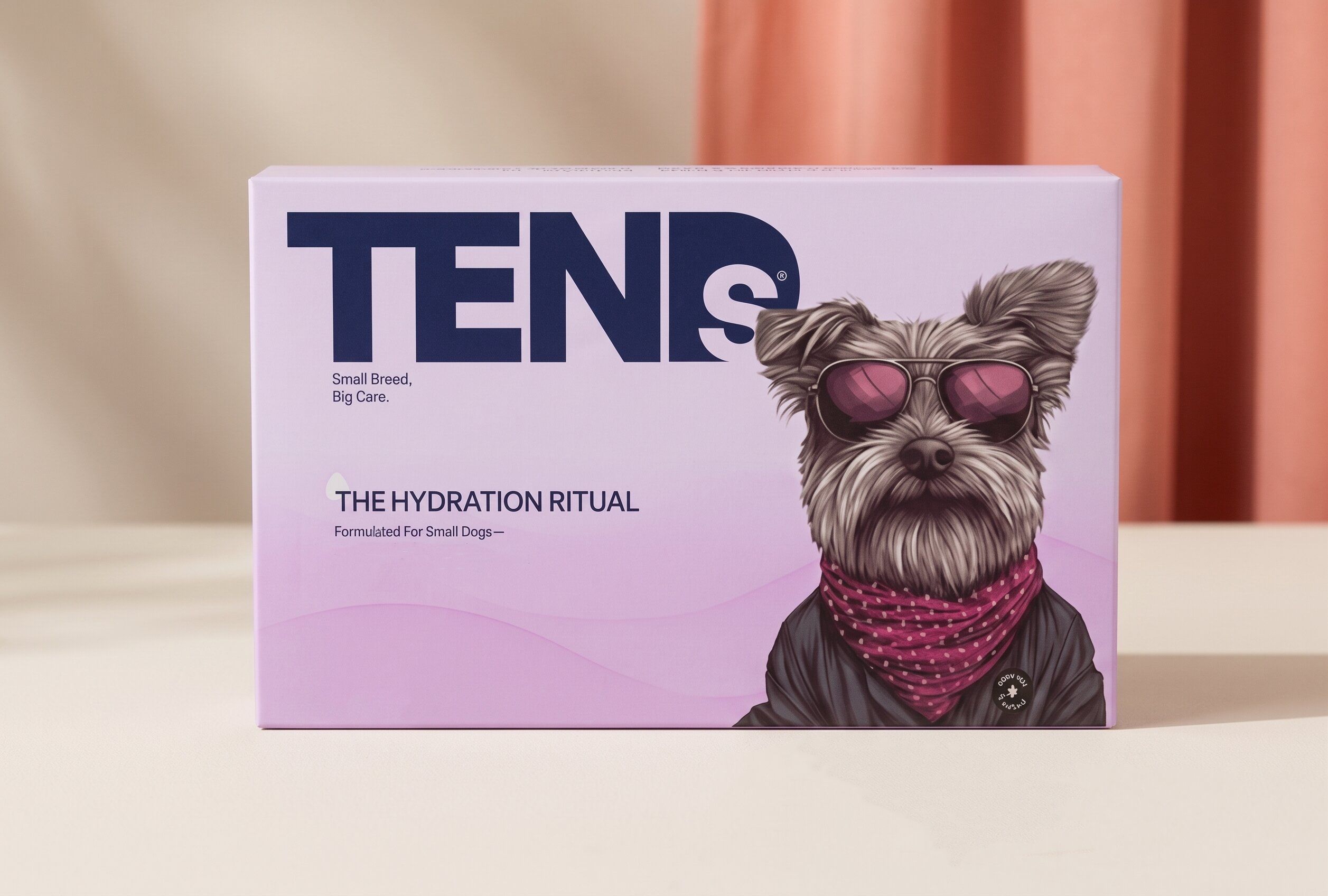
The Hydration Ritual SHINE blend and the Superfood Blend both deliver DHA from microalgae — held inside the algal cell wall rather than pulled out as oil. Whole-cell biomass form. No added antioxidants needed; the cell wall is the packaging.
This way of reading is the system the brand is built on. Less to work with. More riding on it. What gets in, what gets across, what reaches the surface — that’s where the work happens.
The coat is food reaching the surface
What you’ve been watching for weeks is the third-stage read running on what arrived months ago. The bottle is the way in. Her body finishes the read.
Eats it. Absorbs it. Uses it.
Sources
1. Jergens AE, Heilmann RM (2022). Canine chronic enteropathy — current state-of-the-art and emerging concepts. Frontiers in Veterinary Science, 9, 923013. https://doi.org/10.3389/fvets.2022.923013 2. Thomsen M, Künstner A, Wohlers I, et al. (2023). A comprehensive analysis of gut and skin microbiota in canine atopic dermatitis in Shiba Inu dogs. Microbiome, 11, 232. https://doi.org/10.1186/s40168-023-01671-2
Written by the TENDS Nutrition & Research Team
Built within the TENDS small-breed formulation and behavioural framework


Big Brand? No.
A Smaller One — On Purpose.
Stay close for bold new moves in small-breed care.
RESET